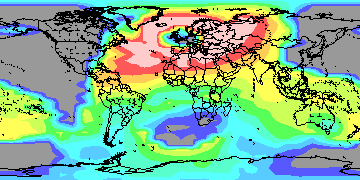
 I said last month that conditions had been dire - and then the flux rose up to 125. Yippee!
Unfortunately, there was flare activity as well, so the bands were up and down with good F2 layer openings, but then aurora as well. I expect conditions to be similar in March with big swings in the solar index as spots rotate into view and then disappear.
This month's predictions are based on a smoothed sunspot number of 39. Expect to see openings up to 15m, perhaps even 12m/10m if conditions continue to improve. March is also good for North/South paths, such as Uk<>South Africa. So good DX.
Anyway, here are the charts.
I said last month that conditions had been dire - and then the flux rose up to 125. Yippee!
Unfortunately, there was flare activity as well, so the bands were up and down with good F2 layer openings, but then aurora as well. I expect conditions to be similar in March with big swings in the solar index as spots rotate into view and then disappear.
This month's predictions are based on a smoothed sunspot number of 39. Expect to see openings up to 15m, perhaps even 12m/10m if conditions continue to improve. March is also good for North/South paths, such as Uk<>South Africa. So good DX.
Anyway, here are the charts.
Monday, 28 February 2011
UK Propagation charts for March 2011
I said last month that conditions had been dire - and then the flux rose up to 125. Yippee!
Unfortunately, there was flare activity as well, so the bands were up and down with good F2 layer openings, but then aurora as well. I expect conditions to be similar in March with big swings in the solar index as spots rotate into view and then disappear.
This month's predictions are based on a smoothed sunspot number of 39. Expect to see openings up to 15m, perhaps even 12m/10m if conditions continue to improve. March is also good for North/South paths, such as Uk<>South Africa. So good DX.
Anyway, here are the charts.

Thursday, 24 February 2011
Ionospheric Sounding and Digisondes
 I recently gave a talk to my local club on ionospheric sounders (Digisondes). I will probably give the talk at the RSGB Convention in October 2011 as it seemed well received. While quite a complex subject, I have added some notes to the presentation to try and make it standalone.
The PDF explains what they are, what they show and how to use them. It also has links to free real-time digisonde plots from around the world and an historical database.
You can download the 4.1Mb PDF here.
I recently gave a talk to my local club on ionospheric sounders (Digisondes). I will probably give the talk at the RSGB Convention in October 2011 as it seemed well received. While quite a complex subject, I have added some notes to the presentation to try and make it standalone.
The PDF explains what they are, what they show and how to use them. It also has links to free real-time digisonde plots from around the world and an historical database.
You can download the 4.1Mb PDF here.
Wednesday, 9 February 2011
Podcast: HF Propagation Report, February 2011

A look at the last 30 days' solar and geomagnetic conditions, NASA's new prediction for Solar Cycle 24, a band-by-band breakdown and a short look at NASA's STEREO spacecraft.
Click on the headline to listen to the programme online or if you prefer to listen to it on your iPod search for G0KYA on iTunes.
Tuesday, 1 February 2011
UK Propagation charts for February 2011
I have now published my UK HF propagation charts for February 2011.
Regular readers will spot a small change - they are now colour coded. I never found the original charts very clear in terms of the reliability of the path, so I have now changed the software to show colour-coding for the reliability.
Don't get too excited as the colours go down to less than 25% reliability - if you are running a SteppIR at 120ft and a linear you might find paths like that opening up. For the rest of us look for reliability of 40-50% or more.
In case you hadn't noticed conditions have been dire for the last week or so - the solar flux is back down to 80-81 and openings on 21MHz and 28MHz are seemingly non-existent.
Or are they?
VP8ORK on South Orkney Island (take a look at map to see where it is - Falklands and head south) has been worked from the UK on both 21 and 28MHz so paths do open up, albeit weakly and not for very long.
Fingers crossed for some more sunspots. For a general overview of propagation conditions please refer to my posting for December/January. While we will move more towards equinox conditions later in the month I think what I said then still stands.
Wednesday, 19 January 2011
Scam warning
I am getting an increasing number of enquiries from people who are either buying or selling amateur equipment. Someone is using my name and callsign to scam people. It isn't just me - there are lots of examples of this now.
The scam is that the seller wants you to send money via Western Union, or will send a cheque (which subsequently bounces). Their English is usually quite poor and, strangely, I don't live in Nigeria!
If you are approached by someone purporting to be me please put a comment on this blog entry. I'm not selling/buying anything at this time.
Steve G0KYA
The scam is that the seller wants you to send money via Western Union, or will send a cheque (which subsequently bounces). Their English is usually quite poor and, strangely, I don't live in Nigeria!
If you are approached by someone purporting to be me please put a comment on this blog entry. I'm not selling/buying anything at this time.
Steve G0KYA
Friday, 17 December 2010
HF Propagation – December/January

G0KYA's propagation charts from UK for January 2011
This is the period when the low bands (160m, 80m and 40m) come into their own. The last two winters have seen great low-band propagation, with stations in the USA and Caribbean being worked on 80m well after sunrise. If you do nothing else keep an eye on 160m, 80m and 40m this winter as the relatively low levels of solar activity, the long winter nights and low D layer absorption means that DX may be heard all night long.
Band by band:
On 160m (1.8MHz or Top Band), solar absorption will prevent skip during the daylight hours. You should be able to work other UK stations out to about 50-80 miles via ground wave. The band will open around sunset and openings up to around 1,300 miles should be possible, with frequent openings up 2,300 miles. DX openings to the east from the UK should be possible around midnight and to the west before sunrise for well-equipped stations.
On 80m (3.5MHz), expect a similar pattern to Top Band with DX openings at night with peaks at midnight and around sunrise (greyline openings). Openings around the UK and out to around 500 miles should be possible during the day and between 750-2,300 miles at night. A low, horizontal antenna will be useful for relatively local, NVIS (Near Vertical Incidence Skywave) signals, but lower angle radiation, such as obtained with a vertical, will be required for DX.
Listen for DX from the West just before and just after sunrise – these are the months you are likely to hear US stations around 3795MHz in the morning.
40m (7MHz) is also another great DX band at this time of year. Forty metres should open to DX is an easterly direction during the late afternoon and towards the south at sunset. Paths during the afternoon may also include W6 (west coast USA) in mid winter. Openings to the west, including long path to VK/ZL should be possible after midnight and should peak just before sunrise. Relatively local contacts should be possible during the day, although low critical frequencies will mean that it is difficult to work other UK stations while perfectly possible to talk to European stations.
20m (14MHz) is likely to provide great DX openings during the hours of daylight. Peak conditions will be a couple of hours after sunrise for paths to the east and a couple of hours before sunset for paths to the west. Contacts up to 2,300 miles should be possible during daylight hours, but the band is likely to close to DX an hour or so after sunset. Occasional DX openings towards South America may be possible after nightfall.
17m/15m (18MHz/21MHz) should provide fairly good DX openings during daylight hours, although 15m may struggle to open at all on some days if the flux doesn’t rise above 80-90. The period from noon to late afternoon may be best, but both bands are likely to close at sunset and remain closed until some time after sunrise the following day.
12m/10m (24MHz/28MHz) may be good or bad depending on how the solar cycle progresses. If the flux stays in the 70s-80s there may be many days where there are no signals at all, although occasional brief openings to DX may be possible. If the solar flux heads towards the high 90s or more than 100 then good DX should be possible during daylight. A brief spell of sporadic-E can sometimes occur in the New Year resulting in very strong, but short-lived propagation on 10m out to around 1,300 miles.
A quick tip – if 28MHz seems dead listen to 27.555MHz USB which is a CB calling frequency. Activity there usually means that 10m may open up shortly after.
Stealth Antennas - now available in USA

My RSGB book "Stealth Antennas" is now available in the USA from the ARRL.
Tiny postage stamp-size gardens, intolerant neighbours, planning permission problems, living in apartments: these are some of the challenges facing the modern radio amateur when trying to get on the air. Stealth Antennas offers clear practical advice to those who might have thought they were unable to put up a suitable antenna.
You can buy it in Europe from the RSGB and in the USA from ARRL.
I'd like to take this opportunity to thank the many US hams who helped with the book by contributing their stories.
Subscribe to:
Posts (Atom)