Showing posts with label MMANA-GAL. Show all posts

Friday, 27 January 2017

A shortened multi-band End-Fed Half Wave (EFHW) antenna for 80-10m

The 80-10m EFHW
This is a shortened multiband antenna, about 23m long, for 80m-10m that offers low SWR (1.3:1) on 80m and 40m, and below 3:1 on 20, 15 and 10m. The antenna has almost 300kHz bandwidth on 80m between 3:1 SWR points. But performance is down about 8-12db on a dipole on 80m.

This design came from attempts to find an 80m antenna that could fit into a small space. This was because Norfolk Amateur Radio Club likes to take part in the 80m Club Championship (we won in 2016), but many members don't have enough space for a full size (132ft) dipole or the 100-102 feet needed for a G5RV or W5GI antenna.

This antenna lets you get on to 80m in a horizontal distance of about 12m (40ft) when used as an inverted sloper with the apex at 8m, although you'll be down a couple of S points on a dipole. But if the other station is 59+20dB, you'll be about 59 +5 or 10db, so all is not lost!

I take little credit for this as it was outlined in PD7MAA's and IK0IXI's blogs after extensive work on the antenna in the Netherlands. However, there was little on their blogs in terms of its performance or SWR characteristics. Hence this write-up.


Download the 80-10m EFHW antenna guide

Update 29/1/17:
I've updated the guide to look at replacing the coil with a 7MHz trap and also putting the antenna up as an inverted V.  The trap and about 14.2m of insulated wire would improve the 80m performance a little, if you have the space, but possibly at the cost of the 14MHz performance. Surprisingly the MMANA-GAL model suggests the inverted V would be worse for 80m NVIS communication.

Update 09/02/17
I thought I would bite the bullet and took the wire and loading coil off and replaced it with about 130ft of insulated wire. This needs some final tuning, but gives a low SWR across 80 and 40m, and SWRs below 3:1 across the higher bands. The last 20-25 feet had to run along a wooden fence. Performance on 80m was equal to or down 1-2 S pts on the W5GI. Performance on 40m was down quite a bit, perhaps 2-3 S pts.

It appeared to be directional compared with the W5GI (which was at right angles). Equal performance on 20m to Tunisia.

So the performance on 80m was marginally better than the shortened version, but the 40m performance was worse. This was confirmed with WPSR tests. The performance on 20m was roughly similar. The bands higher than 20m were mostly closed during the test.

I think the compromise position of the 132ft wire didn't help the antenna's performance and I think that overall, the 66ft and loading coil version was better on 40m an higher.. If you could get the whole wire in the clear you might better results.

Wednesday, 30 November 2016

Quarter wave verticals for HF

The radiation pattern for a quarter wave vertical.
I had an email from a radio amateur who was struggling to work DX after putting up a very off centre fed dipole cut for 40m and fed with open wire feeder.

This is probably not the best way to go about it as the off centre feed can cause an imbalance and create RFI problems.

I suggested a better DX antenna might be a quarter wave vertical cut for the band in question and fed against a decent ground plane. But what is a decent ground plane?

Rudy Severns N6LF has done extensive research on this, but his conclusion was that you really need as many radials on the ground as possible. Up to 120 is optimal, but you will notice an improvement as you add more and more with perhaps 16-32 being the minimum for good performance.

Don't be misled by your SWR meter as a single earth stake may give you a low SWR, but what you are seeing may be the effect of ground losses.

A quarter wave vertical should have a theoretical impedance of about 35-36 Ohms, so if you have a 1:1 match you are seeing 35 Ohms, plus 15 Ohms of ground losses.

As you add more and more radials the SWR may INCREASE. This shows it is starting to get closer to the optimum 35 Ohms.

The goal is to keep on adding ground radials until the SWR stops changing. Then the vertical is working about as good as it can.

Rudy found that once you get above 32 ground radials the improvements start to get more subtle and increasingly minimal.

But how long should the radials be be? A quarter wave radial laying on the ground is detuned so a true quarter wave is no longer a resonant radial, although it is a good overall compromise.

So the golden rule is that for a given amount of wire more shorter radials are better than fewer longer ones. This helps to collect the ground currents around the base of the antenna and improves the antenna's efficiency.

If it is a multiband vertical then the compromise is to make them as long as the antenna is high. If it is a monoband antenna then perhaps a quarter wave is best, although eight "eighth wave" radials might work better than four quarter waves (if on the ground).

In tests though you will find that two resonant elevated radials fitted so that they are at 180 degrees to each other may work as well as eight or so random radials on the ground. Rudy suggests that more resonant quarter wave elevated radials may be better still, but its starts to get a bit unwieldy.

A few years ago my club used a quarter wave vertical cut for 40m and fed against two elevated quarter wave radials and it worked very well. For contacts out to Germany from the UK there was little in it compared with a horizontal half-wave dipole at about 40 feet. Closer-in contacts were louder on the half wave horizontal dipole due to the different radiation pattern, but for DX the vertical was better.

You can see this with the MMANA-GAL antenna modelling software.

We also used it on 21MHz where it was a three quarter wave vertical and ended up working India (VU).

As you can buy 10m fibreglass fishing poles for about £30 you can make an effective quarter wave vertical for very little money.

The length of the radiator will then be 300/7.1MHz = 42.25m/four = 10.56m.

If using PVC-coated wire the adjusted length will be about 10.56m x 95% = 10.03m, although start a little longer and fold or cut to get the SWR minimum.

For a 30m quarter wave vertical the sums are:

300/10.1MHz = 29.7m/four = 7.42m or about 7.054m if using PVC-coated wire.

Once optimised expect to see an SWR of about 50 Ohms/36 Ohms (the impedance of a quarter wave vertical) = 1.4:1 or 1.5:1 NOT 1:1.

Although putting a quarter wave vertical (or Hustler/Butternut) on a single earth stake will work, you are throwing away its efficiency.

Why not try building one and let me know how you get on?

Monday, 12 October 2015

RSGB Convention, October 2015

I gave two talks at this year's RSGB convention. The first was on HF Propagation and I'd like to remind readers that I have a video presentation with audio that is available for RSGB-affiliated clubs.

If you would like your club to have a copy get your programme secretary to drop me an email at steve [at] infotechcomms.co.uk. I can also do a Skype-based Q&A after the presentation in most cases.

Otherwise, there is always the free "Understanding LF and HF Propagation" e-book to download.

The other presentation was on "An introduction to antenna modelling with MMANA-GAL". This is available for download. Don't forget that my three books are also available from RSGB ;-) or you can use the links on the right.

Monday, 19 May 2014

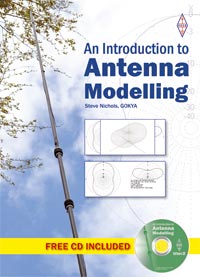
An Introduction to Antenna Modelling

Just a quick reminder that my new book "An Introduction to Antenna Modelling" is now available.

The book looks at the free MMANA-GAL antenna modelling program that lets you design and optimise a whole host of antennas – all on your PC.

It shows you step-by-step how to input antenna designs into MMANA-GAL, how to adapt designs you are given and how to optimise your designs for the best performance.

By the time you have finished you should be able to model a whole host of antennas including dipoles, the G5RV, the W3DZZ trapped dipole, verticals, off-centre fed dipoles (OCFD), magnetic loop antennas and many more.

The book also includes a CD-ROM that not only contains the MMANA-GAL software so you can get started immediately, but sample antenna files too. It also includes other antenna modelling software including EZNEC, MININEC Pro and 4nec2. Plus there are also more than 30 other amateur radio programmes included.

The RSGB has also managed to keep the price below £10.

See the RSGB shop.

Tuesday, 30 April 2013

NEW! The multiband trapped EFHW HF antenna

The 20-17-15m trapped EFHW

Ever since I first published the details of the original monoband EFHW people have been asking me can you design a multi-band version? My stock answer has always been "no" – I couldn't see how I could.

Anyway, this had been bugging me for some time. I tried modelling a version that could use parallel-fed half-wave radiators, but it didn't work.

I had always dismissed traps as these are used on quarter-wave radiators so they wouldn't work on a half-wave design – or would they? Turns out they do. I started modelling an antenna in MMANA-GAL and found that you could make a 20-15-10m EFHW using traps for 10m and 15m. But you would need a variable capacitor to bring the EFHW tuning unit to resonance.

This actually makes sense as the end of an EFHW is at the same impedance as the end of a quarter-wave vertical, so a trap does the same thing on a half-wave design. All you have to control is the feedpoint impedance.

Doh! – why didn't I think of that earlier?

The result is my first working prototype of a 20-17-15m multiband trapped EFHW, which seems to work well. I have updated the PDF to show how this was done. Development work has continued and one can now be built with a single matching box that doesn't need a variable capacitor at all, just the original coax capacitor.

Download the PDF with the complete EFHW story.

Tuesday, 6 March 2012

Using MMANA-GAL for antenna modelling


I gave a talk on antenna modelling using the free MMANA-GAL software at my local Amateur Radio Club. It looks at what MMANA-GAL is, how to use it and then a number of different applications.

Some of these are useful and surprising - like how to optimise a 40m off centre fed dipole (Windom) so that you can get 15m. And how mounting an antenna as an inverted V can seriously change its radation pattern or number of bands available.

It also asks the question is the G5RV really a good multiband antenna? Why was my W3EDP end fed better to the south-east and south west and rotten to the north. And does the DL7PE Microvert radiate off its feeder?

Download the presentation in PDF format with the notes included (8.8Mb).

Note: I have also made available a Zip file with some .maa files including the End fed Half Wave, Rybakov vertical, DL7PE Microvert, 80cm magnetic loop, 65ft Inverted L, EH antenna, 20-15-10m trap dipole, 80m OCFD (Windom) and an experimental W5GI mystery antenna file. Download the MMANA-GAL antenna files.