Sunday, 21 February 2016

Worked All States, QRP and magnetic loops

MFJ-1786 magnetic loop for 30m-10m
This weekend was the ARRL CW DX contest where US stations work the rest of the world. This was a good opportunity to try and work the rest of the states I need for my Worked All States award.

I need Alaska, North Dakota, South Dakota, Wyoming, Rhode Island, West Virginia and Nebraska.

I have actually worked quite a few of these, but those stations are not on Logbook of the World (LOTW).

Anyway, starting at the bottom of 14MHz I soon came across KI1G in Rhode Island and bingo! He was in the log with 100W to the OCFD.

I never found any of the other states I needed, but on Sunday I came across N8II in West Virginia and bingo, worked him too. Unfortunately, he isn't on LOTW – damn! I'm not sure if you can do a mixed entry with part LOTW and part QSL cards, like I did with my DXCC application. It might come to that.

Anyway, with no sign of the Dakotas or Nebraska (don't even mention Alaska), I thought it would be fun to try some QRP.

With just 5W I soon worked Connecticut, Pennsylvania and Massachusetts with the OCFD. Time to up the game.

So I rigged up my MFJ-1786 mag loop on a 12ft pole in the back garden. This was about two S points down on my usual 40m half-wave OCFD, but I was able to work the eastern states on 20m in very short order. I also worked N2IC in New Mexico, W2UP Colorado and N9RV Montana on it.

So what about QRP and a magnetic loop?

A bit harder, but North Carolina, Tennessee, Vermont and Virginia were soon in the log with 5W on 15m.

Now, don't get me wrong, it is the antenna at the other end of the contact that was doing all the hard work, but if anyone says they haven't got room for HF antennas tell them about the MFJ-1786. It's a miracle for hams with little space.

So I'm hoping that Rhode Island gets confirmed on LOTW. I then need to think long and hard about Alaska. That is going to be a tough one. And if I can get the others confirmed with QSL cards Worked All States (WAS) is a possibility.


Friday, 12 February 2016

Radio Norfolk interview about Tim Peake and ISS

ESA astronaut Tim Peake.
I was lucky enough to hear astronaut Tim Peake's ISS contact with another UK school on Thursday 11th February 2016.

Not only did I record it, but I sent out a press release and ended up being interviewed about it by BBC Radio Norfolk.

The Norfolk Amateur Radio Club had put on a workshop the next day at the City of Norwich School for students who are going to be involved in their contact with Tim in two weeks, so it was very fortuitous.

You can hear the ISS downlink on 145.800MHz and you don't need a particularly fancy antenna.

If you do hear and record Tim do contact your local media as they are fascinated by the whole business and it brings good PR for amateur radio in general.

Anyway, here is the audio from Radio Norfolk in MP3 format.


Saturday, 9 January 2016

HF Propagation charts for the UK updated

I've now updated my propagation prediction charts for the UK through to April 2016.

See http://www.infotechcomms.co.uk/propcharts/

I've used the latest smoothed sunspot numbers from NOAA in the US. There is little point in updating them much further than four months as the SSNs change, and it takes me about three hours to do four month's worth of charts and upload them - that's a chart for every hour and for every band or 24 x 8=192 charts per month.

It is interesting to see how the solar cycle is falling away. In January 2015 the SSN was 62, now it is just 45. The coming months will see further falls.

This means that we will see fewer openings on 12m and 10m, but 15m should still open up at times. I worked the US Virgin islands on 15m CW this morning and it was open to the eastern seaboard of the US this afternoon so don't write it off.

The new
web based version of ITURHFPROP
The RSGB Propagation Studies Committee, of which I am the chair, is also working on a new online HF prediction system based on the ITU program ITURHFPROP.

This uses a different, but newer, ionospheric model to the VOACAP engine normally used, but the original ITURHFPROP software is not very easy to use.

But thanks to the work of Gwyn Williams (G4FKH), James Watson (HZ1JW) and Chris Behm we are getting closer to a web-based version. You can try the test model at http://www.predtest.uk/

Ultimately, it will have the ability to produce point to point predictions as well, just like VOACAP Online. But lets learn to walk before we run.

It will be interesting to compare the two models and Gwyn would welcome any feedback. His email details are on the web page for the new model

Friday, 8 January 2016

Tim Peake - first UK schools contact on 2m from ISS

ESA astronaut Tim Peake. Image: Steve Nichols
Tim Peake, the UK ESA astronaut, made his first schools contact this morning, 8th January 2016.

The ISS appeared over the horizon here in eastern UK at 08:49hrs and vanished at 08:55hrs. I monitored the downlink signal on 145.800MHz and it appeared at about 08:52hrs. Tim appeared to be having problems with the original uplink frequency and so they switched to another.

It was a short pass, but the school - Sandringham School in Hertfordshire - still managed to ask some questions. Unfortunately, they lost the ISS signal before they finished and were able to say goodbye.

I've attached an audio recording of the pass as captured via a 2m Slim Jim in the loft and an Icom IC-7400. The recording was made with RecAll and processed with Audacity.

I also heard him at times on a 2m handheld, but I wouldn't recommend it as it was not as strong.

I'm very proud to be be part of the team that will enable the next schools contact in late February 2016 when Tim will talk to the CNS School in Norwich. The exact date and time has yet to be decided.

I was lucky enough to interview and photograph Tim professionally for "ADS Advance" magazine last year.

Download the MP3 audio file of Tim Peake


Thursday, 24 December 2015

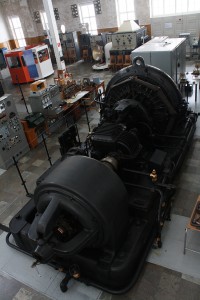
SAQ transmission on 17.2kHz from Sweden, 24th December 2015

The 200kW Alexanderson alternator
I heard and recorded this morning's 200kW SAQ Christmas transmission from the Alexanderson alternator at Grimeton, Sweden - see http://alexander.n.se/

I used a Perseus SDR and a home-made miniwhip to Roelof PA0RDT's design at about 8m high. The signal was loud at about S9 +20dB - much better than I thought it would be, but this was down to the brilliant tiny antenna.

I managed to extract the audio and make an MP3 file from it, so you can hear it yourselves and decode the CW if you wish. Note that at the end of the MP3 file you'll hear the tone die away as they switch the alternator off and it slows down!

There are few glitches as the computer struggled to record it, but you only lose the odd character!

Download the MP3 file

Monday, 21 December 2015

Rockmite 40m fixed and working

I unearthed my 40m Rockmite that I built years ago for a QRP session today.

First problem I noticed was that it wouldn't work with a paddle, only a straight key. The second was that I only had audio from one of the ear buds.

I thought this was a dirty connection so tried cleaning the contacts – no good. Turned out to be a poor joint on the back of the 3.5mm socket. In fact, I'm amazed it ever worked at all!

Now on to the problem with the paddle. The Rockmite will default to straight key mode if you fire it up with a straight key attached and that should have been the clue.

Pulling the front panel off I could see that the quarter inch socket for the Morse key/paddle had rotated and was shorting out one of the contacts that would normally go to the middle of the plug.

The Reverse Beacon Network proves you are getting out!
Once that was sorted the keyer burst into life. Connecting the Rockmite up to a W5GI dipole and sending a few CQs showed that I was being picked up all over Europe with about 0.75W (I normally send “1W” as it is easier).

Anyway I answered a CQ call from DF1UQ QRP he came back to me – wonder of wonders. I gave him 559 and he gave me 529. Turned out Klaus was running 4W. There was a lot of QRM from other stations in the late afternoon so I kept it fairly short, but the Rockmite works again.

I still think the sidetone is a bit harsh, but there is a mod for that if I was that bothered. You'll also see that I have a knob on the front that says VXO. This was an attempt to connect a variable capacitor in line with the crystal to allow me to move the frequency a little. All I got was hum so I abandoned that – one day I'll have another go.

I still think the 40m Rockmite has an amazing receiver for its size and price. The newer ones from Kanga UK/QRPMe are even better. It is definitely better than the Foxx-3, although that is self-contained. Both nice QRP projects to build though.

I'm trying to clear the decks of QRP projects/repairs so that I can concentrate on building my Elecraft K1 kit that was a Christmas present in 2004 – about time it was built I think!

Update 31/12/15
Just replaced C8 with a 0.01uF capacitor and that has quietened down the sidetone volume a little. Also put a 6.8mH choke in line with the crystal and small polyvaricon and am getting about 2.5kHz of swing around 7.030MHz which makes it a little more versatile. This was at the end of the crystal nearest Q2.

Wednesday, 16 December 2015

20m Spitfire Rockmite is joined by 40m FOXX-3


The 40m Foxx-3 - the big red button is the Morse key.
Click to enlarge any image on this page.
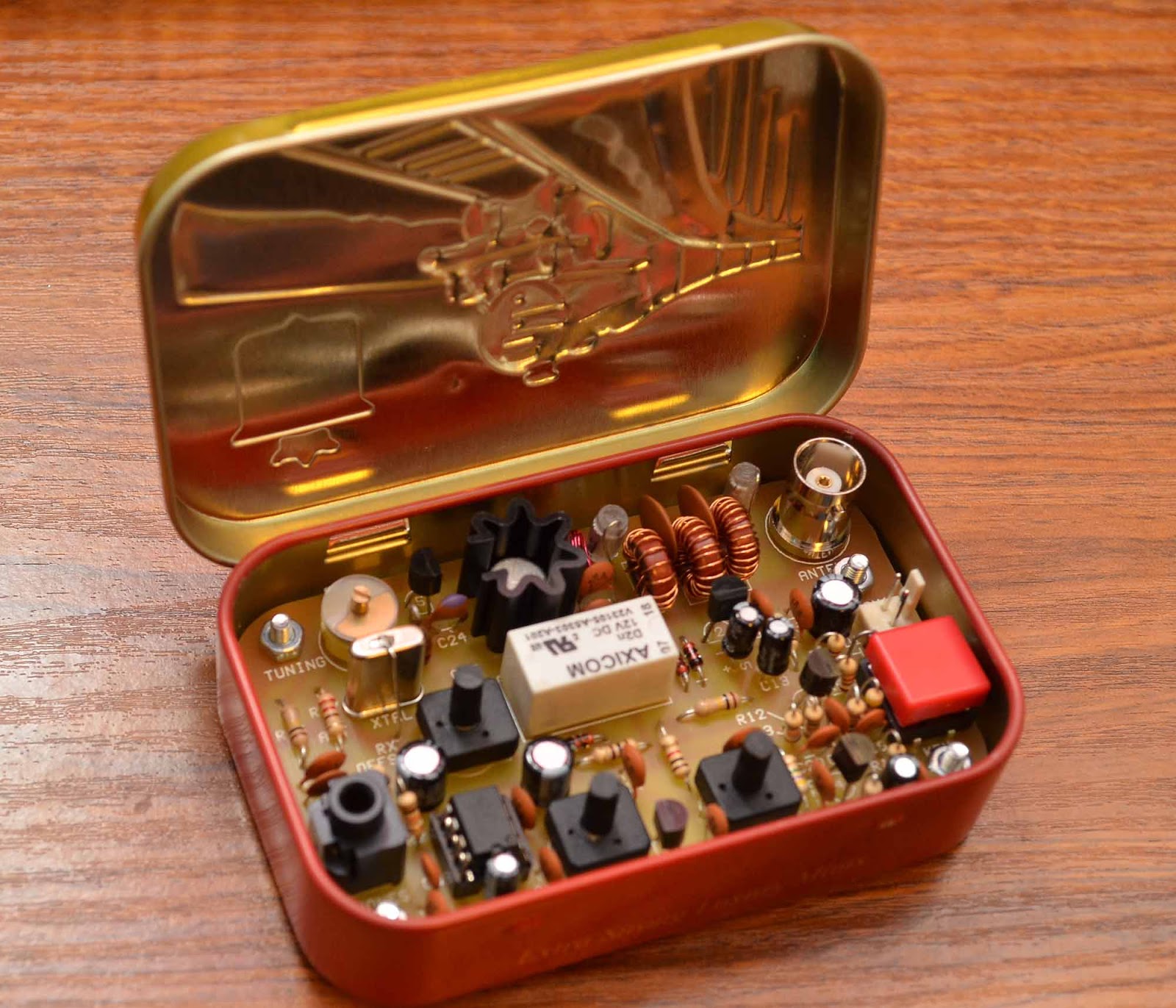
Back in July I wrote about the 20m Rockmite I built into a Stewart's mint tin. Well, now it has been joined by a 1W 40m FOXX-3 transceiver, also from Kanga Kits in the UK, but this time we have a steam locomotive on the lid.

The Foxx-3 is a well-known design that has evolved from George GM3OXX's original Foxx into its latest “-3” incarnation, designed by Derek G4GVM.

I won't go into how it works – you can find out more on the Kanga web site.

The build was quite easy – the first thing to do it drill the mint tin for the PCB stand-offs and open up the holes with a needle file. I used the PCB as a template for that.

The build sequence has good documentation, all the stages are in different bags and you can test each stage as you go.

The first stage to build is the audio amplifier with an LM386 and you test that by touching the volume control connection and seeing if it hums – no problem.

The second stage is the keying circuit, which again is easy to check. I opted for the push button Morse key on the board rather than a socket for a Morse key as this is really just a toy for me.

A slight amount of switchover delay is set by the value of a resistor. I stayed with the suggested value and that seemed fine.

The third stage is the sidetone circuit, which once again worked first time.

Stage four is the crystal oscillator and I had an issue here that when I keyed up the TX note was very wobbly. I read elsewhere that this can be normal until you build the final stage to give it a decent load. This turned out to be the case.

Testing testing!
The final stage is the power amplifier and filter, complete with four tiny toroids. Again, not difficult, but make sure you get the coating off the enamel before you finally solder the toroids in. I used a drop of molten solder on the iron to do this and it seemed to work OK.

The final stage was to put the BNC on the board and I had to increase the temperature of the iron for this as it acts as an effective heat sink.

Finally, it was a case of wiring it up to a 12V lithium ion battery, connecting a a 40 OCFD antenna and headphones and seeing if it worked.

The power output was just under 1W so I left it as it was – you can change a resistor to increase/decrease the power level up to 1W maximum.

Well, the RBN picked it up even if no one came back to me.
Using my Icom IC-756 Pro3 I checked where it was transmitting and adjusted the variable capacitor to put it on 7.030MHz. I then transmitted on 7.030MHz on the Pro-3 to adjust the sidetone offset. I found that this had a limited range before the receiver either went deaf at one end of the range or just hummed at the other. I did quite a bit of to-ing and fro-ing until I was happy – you'll see that one of the skimmers logged me on 7.0299MHz as I adjusted it.

I think that once it is set it is best to leave it.

I also found that I needed to use my ATU to avoid AM breakthrough on my W5GI dipole – the 40m Windom was OK. I had been warned about this.

The finished item in a Stewart's mint tin.
A few CQs using the built-in Morse key had me spotted on a few RBN skimmers in Europe. You can see that my reported speed varies from 13-15wpm as it is very hard to be consistent with a push button Morse key! It is also hard to send the highly-accurate Morse needed for skimmers to decode you, so I was pleased to be picked up in the UK, Ireland, Belgium and Germany during the daytime.

The reported 15-20dB SNR means it should be possible to work people with 1W, although no-one has come back to me yet and I haven't heard anyone call CQ who has been spot on my frequency.

The receiver is reasonably lively and you'll hear anyone who can hear you I guess.

The only issues were mechanical – make sure that when you put it in the mint box that you have enough room for the BNC plug to fit. I need to open up the holes on the PCB board by about 0.5mm to allow space for it to be connected. Doh!

I also had to grind down the three controls on the variable resistors to allow the lid to shut properly.

In all then, the Foxx-3 is a great little kit to make and it obviously works. Don't expect Elecraft KX-3 performance though! It only costs £29.95.

I do think that you will work other hams on it though, at least on the 40m version, and my thanks to Dennis at Kanga for selling it. The next project is an Elecraft K1 kit that I bought back in Christmas 2004 and has been living in the loft unassembled ever since. Shame on me!

Incidentally, the tiny zip-up nylon camera cases for sale in Poundland are ideal for storing and carrying mint box radios like the Rockmite and Foxx-3.