Wednesday, 13 October 2010

More on the 20m EH antenna


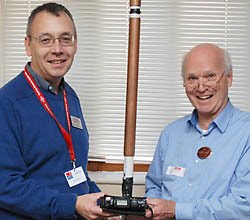
I recently attended a lecture on small antennas at the RSGB convention by Professor Mike Underhill G3LHZ (pictured on the right with me). Mike asked me to take my 20m EH antenna along (which has been featured on this blog) so that he could take some measurements with his miniVNA.

I set it up on a tripod in the seminar room and hooked it up to my Yaesu FT-817. What surprised me (and the delegates) was the fact that it was receiving signals from around Europe at up to S9 +20dB.

OK, a dipole could have done the same, but for a four foot antenna mounted on a tripod indoors that's pretty good. The antenna was built for my RSGB "Stealth Antennas" book (available now from RSGB and on their website soon) and has now been put back in my loft, where it happily offers a 1.4:1 SWR and signals that get close to my other antennas, sometimes beating them.

Say that it works by Poynting Vector Synthesis (PVS) and the experts go mad. But think of it as a short, fat dipole with a matching network and it still does the same job and everyone is happy ;-)

As one delegate said: "My friend lives in a flat and would love one of these".

Click on my link to read more
or see http://groups.yahoo.com/group/eh-antenna/

UPDATE: "Stealth Antennas" now for sale on RSGB website.

Monday, 11 October 2010

Podcast: HF Propagation Report, October 2010


A change to the usual format this month. This Podcast features interviews with Dr Lucie Green, a solar physicist, who talks about her work on coronal mass ejections, and with Carl Luetzelschwab K9LA about what drives Top Band propagation and what to look for on 160m this winter.

Click on the headline to listen to the programme online or if you prefer to listen to it on your iPod search for G0KYA on iTunes.

Tuesday, 5 October 2010

HF Propagation Predictions, October 2010

Note: You can find HF short-path propagation prediction charts from the UK at: http://www.infotechcomms.net/propcharts/ Solar conditions improved over the last month. As I write this on 5 October the solar flux is 76, but it did touch 91 during the last 30 days. HF conditions have improved dramatically, but this is mainly due to the seasonal change. If you haven’t been on HF for the last few months get on now! Openings have included 10m paths to Malaysia and VK, although I couldn’t hear them. 21MHz (15m) is opening up reliably – the US is easily workable at times. I worked W8FHF in Ohio using 100W to a long wire laying on the roof – he was stronger on that antenna than any of the others. 7MHz (40m) is also showing great promise. You can hear the US in the evening quite well and morning openings to VK are possible. Gerry VK7GK in Tasmania was 59 on 7.160MHz the other morning (long path) and gave me 57 on the Windom. October also brings CQWW which always brings out the DX, so get on the bands. Now lets look at the rest: The equinox periods provide longer daytime periods than winter, but logically, shorter night-time periods too. These tend to be the best months for working North-South paths, such as UK to South Africa and South America. On 160m (1.8MHz or Top Band), look for short-skip and DX openings at night. Again, no daylight skip is possible due to absorption, but openings out to 1,300 miles and occasionally further afield can be expected at night with conditions peaking around midnight and again at sunrise (greyline). 80m (3.5MHz) will generally follow the characteristics of Top Band at night, but will also provide good openings out to around 250 miles during the day. These will lengthen to around 500-2,300 miles at night with fairly good DX opportunities at times. At this point in the cycle 80m should still provide good DX as absorption is still quite low. 40m (7MHz) Forty metres should open to DX in an easterly direction at sunset. Openings to the west should be possible after midnight and should peak just before sunrise. Contacts should be possible during the day, although, again, lower critical frequencies may mean that it is difficult to work other UK stations while perfectly possible to talk to European stations. If the flux rises then 40m may open up to NVIS contacts around the UK. Look out for long path openings to VK/ZL in the morning too. 20m (14MHz) is likely to be the best DX band between sunrise and sunset. The bands may occasionally open after dark, perhaps to the south west form the UK. Good openings will be possible during daylight hours out to around 2,300 miles. 17m/15m (18MHz/21MHz) should provide fairly good DX openings during daylight hours, especially to Africa and South America, with 17m being open more often than 15m. Once again, 15m may struggle to open during times of low solar flux, but could provide good openings if it rises above about 80-90. Be prepared for some surprises though as this is a good month for 15m. Both bands are likely to close after sunset towards the end of the month, although do check for openings after dark as they can occur. 12m/10m (24MHz/28MHz) These could be disappointing bands if the solar flux remains low. If the solar flux heads towards the high 80s/90s then openings will occur on both bands, although 24MHz will open first. If it breaks the 100 mark then expect to see some good DX openings on 10m, especially in late autumn. You can find HF short-path propagation prediction charts from the UK at: http://www.infotechcomms.co.uk/propcharts/ You can also listen to Steve G0KYA's HF propagation podcast on iTunes or at http://www.g0kya.blogspot.com/ Steve G0KYA RSGB Propagation Studies Committee

Friday, 1 October 2010

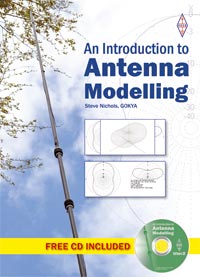
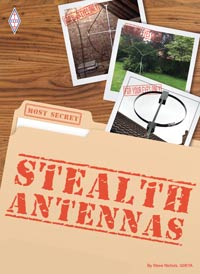
New stealth antenna book released


I’m pleased to announce that my new book “Stealth Antennas” was launched at the Newark Hamfest in the UK. The book is now available to buy from the RSGB .

It will also be available from the ARRL in due course.

It looks at a host of stealth antennas, including indoor dipoles, magnetic loops, stealth verticals, flagpoles, birdhouses and others. It also looks at more esoteric designs like the EH, Microverts, microloops, Isotrons, plus lots of case studies from around the world.

There are details on safety, minimising RFI, ununs, baluns, EFHW matching, the Rybakov – even a zig-zag portable dipole that fits in a folder.

Keep an eye open for it at rallies too.

UPDATE: Now for sale on the RSGB website.

Steve G0KYA

Wednesday, 29 September 2010

Propagation talk at Newark Hamfest, Oct 2010


I will be giving a talk on HF propagation and prediction programs at the Newark Hamfest on Friday 1st October. I've made the presentation available as PDF file so that anyone who attends can download it. It may not make as much sense as it will with my commentary, but there is some useful info there. It is about 7Mb.

Click to download the presentation
.

Friday, 17 September 2010

History of ships' radio room clocks

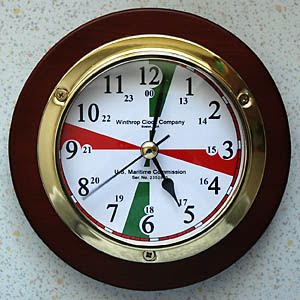
Remember when all ships had real radio operators? If you do you'll know that the ops had to maintain "silent periods" when they wouldn't transmit, instead listening for distress calls on 500kHz and 2182kHz. For this they had a special radio room clock with sectors marked on it.

After the loss of the Titanic, the radio frequency of 500 kHz became an international calling and distress frequency for Morse code maritime communication. For most of its history, the international distress frequency was referred to by its equivalent wavelength, 600 meters, or, using the earlier frequency unit name, 500 kilocycles [per second] or 500 kc.

2182kHz was added later and transmissions on 2182 kHz commonly use single-sideband modulation (SSB) (upper sideband only). However, amplitude modulation (AM) was often used in some parts of the world.

Maritime coastal stations used to maintain 24 hour watches on these frequencies, staffed by highly-skilled radio operators.

As a reminder, a ship's radio room clock would have the 500kHz silence periods marked by shading the sectors between h+15 to h+18 and h+45 to h+48 in RED. Similar sectors between h+00 to H+03 and h+30 to h+33 were marked in GREEN, which is the corresponding silence period for 2182 kHz.

Anyone breaking the rules would soon hear "QRT SP" in Morse Code, meaning "STOP SENDING - SILENT PERIOD!"

I've always wanted to have one of these clocks for my own shack, but couldn't find one. So … I decided to make one. I spent two days with a graphics program recreating a radio room clock from the Winthrop Clock Company of Boston, Ma., USA. It wasn't easy, but I then took the finished result, printed it and pulled apart a quartz clock that I bought for the job and installed it - what a lot of work!

The end result is shown in the photograph above and creates quite a lot of attention in my shack. It also keeps time really well too!

There is even The Radio Maritime Day each April where you have to obey the silent periods, so it comes in useful

Anyway, after all that work it seemed a shame to waste the artwork. I then found that I could upload it to a company called CafePress, letting people buy their own clock. While I was there I also designed some T-shirts, mugs, mouse mats and other goodies.

These products, including a reproduction radio room clock, let you relive those bygone, halcyon days when "sparks" ruled the maritime airwaves. So your shack can now look like a ship's radio room!

Go to https://www.cafepress.com/theradioroom – you can select the currency you wish to pay with.

I have one of the new Cafe Press clocks - it is about 10 inches in diameter and very striking. It is quartz powered so keeps good time and the tick isn't too loud either. Looks very nice on the wall and not too expensive either.

But remember QRT SP!
Friday, 10 September 2010

Podcast: HF Propagation Report, September 2010


Report for September 2010 with a look at how solar cycle 24 still isn't going too well and why HF conditions will now start to improve in September and October. Just click on the Podcast headline above or search for G0KYA on iTunes.