Monday, 23 April 2012

GB0CMS makes nearly 500 contacts in 40 countries.

NARC member and local TV weatherman Jim Bacon, G3YLA,
operating the Caister station GB0CMS. (Steve Nichols G0KYA)
I was part of the team that operated GB0CMS in Caister (Norfolk) on Saturday as part of International Marconi Day. We had two stations - one on 40m and the other on 20m, operating both CW and SSB.

It turned out to be our best ever effort - we worked 487 hams in 40 countries and got as far afield as Austraila (VK5), Barbados (8P), the US (out to Ohio), Canada and Asiatic Russia (UA9).

The reason I'm telling you this is because we tried a new antenna for 40m - the W5GI "Mystery Antenna".  In fact, I only finished making it a day or so before the event so it was largely untested.

I've used one of these at home for a while and it works very well on 80m and 40m, especially if you can't fit an 80m dipole in. You can find out more on my W5GI post above, but everyone who used it was impressed and we got some very favourable reports. I find at home that it often breaks pileups on 40m even though it rests on the apex of the roof tiles!

On 20m we used my vertical end fed half wave (EFHW) design, but with a few tweaks. To stop RFI, which has plagued us in previous years, we mounted both antennas further away and I added four 10ft ground radials, earthed the matching unit to the screw-in base mount and also put a choke (line isolator) about 20ft back from the antenna. The radials are not as crucial as with a quarter wave design as it is a high impedance feed point. However, a few won't hurt and neither will the earth. The choke stopped currents flowing on the braid back to the radio. If I am operating just one radio this isn't quite so necessary.

It did the trick and we were able to operate the two stations with no mutual interference and no lost keyers or interfaces when RF gets into the cabling.

If you worked us on Saturday take a look at this short video shot by Kevin M0UJD.

Thursday, 5 April 2012

Titanic 100th anniversary book - now available as an ebook too

The book "The loss of the Titanic - its story and lessons", which I helped republish, is also now available as an ebook as well as a paperback - just ready for the 100th anniversary!
Lawrence Beesley was a science teacher, journalist and author who was a survivor of the Titanic tragedy in 1912. In this dramatic real-life tale Beesley tells first hand what it was like to be on the Titanic as it plunged into the icy waters of the North Atlantic on that fateful night.
As well as describing the voyage, the collision with the iceberg and the subsequent sinking, Beesley documents what could have been done to save the 1,500 plus people who perished.
Cover of Titanic bookHis account, and others, resulted in many changes to maritime law and procedure in an effort to make sure that a disaster of Titanic’s proportions should never happen again. “The loss of the S.S. Titanic – its story and its lessons” was first published in 1912, shortly after the disaster.
Now republished by InfoTech Communications, ahead of the 100th anniversary of the accident, the 116-page paperback book is available via Lulu.com, delivered straight to your door wherever you live in the world.
Find out more

Thursday, 22 March 2012

Keep Calm and Work Some DX


This is a bit of fun. It is a take on the British WW2 "Keep Calm and Carry On" posters.

"Keep Calm and Carry On" was a propaganda poster produced by the British government in 1939 during the beginning of the Second World War, intended to raise the morale of the British public in the event of invasion.

Seeing only limited distribution, it was little known.

There were only two known surviving examples of the poster outside government archives until a collection of about 20 originals was brought in to the Antiques Roadshow in 2012 by the daughter of an ex-Royal Observer Corps member.

But now you can wear your own "Keep Calm and Work Some DX" T-shirt, baseball cap or own a mouse mat thanks to Cafe Press.

See www.cafepress.co.uk/theradioroom

Tuesday, 6 March 2012

Using MMANA-GAL for antenna modelling


I gave a talk on antenna modelling using the free MMANA-GAL software at my local Amateur Radio Club. It looks at what MMANA-GAL is, how to use it and then a number of different applications.

Some of these are useful and surprising - like how to optimise a 40m off centre fed dipole (Windom) so that you can get 15m. And how mounting an antenna as an inverted V can seriously change its radation pattern or number of bands available.

It also asks the question is the G5RV really a good multiband antenna? Why was my W3EDP end fed better to the south-east and south west and rotten to the north. And does the DL7PE Microvert radiate off its feeder?

Download the presentation in PDF format with the notes included (8.8Mb).

Note: I have also made available a Zip file with some .maa files including the End fed Half Wave, Rybakov vertical, DL7PE Microvert, 80cm magnetic loop, 65ft Inverted L, EH antenna, 20-15-10m trap dipole, 80m OCFD (Windom) and an experimental W5GI mystery antenna file. Download the MMANA-GAL antenna files.

Thursday, 16 February 2012

Podcast: HF Propagation, February 2012


In this month's podcast I look at current solar conditions and how the solar flux index has actually come down - have we seen the peak of cycle 24 or is there more to come? Also, I look at the geomagnetic figures behind last month's visible aurora. And do we really need high solar flux numbers to work DX on 10m - you might be surprised. Lasts about 6mins 15secs.

Click on the headline to listen to the programme online or if you prefer to listen to it on your iPod search for G0KYA on iTunes.

Monday, 6 February 2012

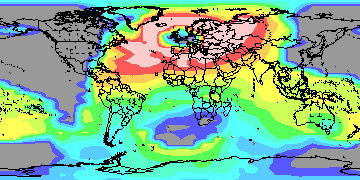
UK propagation charts for February 2012

Solar conditions have declined over the last month. Just a few weeks ago we were suffering from geomagnetic disturbances, with reports of aurora being seen in northern England. And now we have seen the solar flux fall to around 100-110. This doesn't bode well for the rest of the cycle, although there is still plenty of DX to be had. Just the other morning I heard a station on from Tinian Island, Marianas on 10m SSB. He peaked at 55-56 before vanishing. In case you have never heard of Tinian island it is where Enola Gay set off from for Hiroshima in 1945. Other DX that has been romping in includes the VP6T DXpedition to Pitcairn Island and the HK0NA Malpelo DXpedition near Columbia. We may start to see the best of the low-band DX (80m and 160m) fade out a little as we head towards spring, and 10m may not play ball as much if the flux remains down below 120. But keep an eye out as there will be plenty on the other bands. Go to the February propagation charts from the UK

Tuesday, 3 January 2012

UK propagation charts for January 2012

Good solar conditions continue and we seem to have gone through quite a long period of settled geomagnetic conditions, which has helped no end. The solar flux index has hovered around the 130 mark with no really large fluctuations and as a result we are still seeing the higher bands come to life, notably 10m. But this is really the month for good low-band openings - 160m, 80m an 40m. Tony G3ZRJ reported hearing long delay echoes on 80m at about 2100z on 1st January 2012. These are either signals coming around the world "the wrong way", or aided by magnetospheric ducting, or some other form of propagation that we don't really understand. Whatever, it makes for some interesting effects. You can read more about one ham's views on LDEs here. Just want to take this opportunity to wish you all a happy new year and remind you that you can still download a FREE guide to ionospheric propagation written by Alan Melia G3NYK and me. Go to the January propagation charts from the UK