Monday, 10 October 2011

RSGB Convention updates

A few updates for people who were at the RSGB Convention this weekend.

  • I have now updated the "Propagation to T32C" presentation to include the actual results we are seeing as at 9th October. There is a good fit with the predictions. Go to the T32C page
  • You can also download the Ionospheric Sounders presentation given at the Contest University
  • Carl K9LA talked about greyline propagation and mentioned my earlier research on the subject - you can read more here.

Steve G0KYA, 10th October 2011

Tuesday, 4 October 2011

UK propagation charts for October 2011

This is what we have been waiting for. A high solar flux, autumnal conditions and DX rolling in. So get on the bands! We have recently seen the solar flux index hit record highs for this cycle, but the sun has since calmed down a little. But with the SFI still being well over 100 we are seeing 10 metres open up to much of the world. It is quite possible to work the USA this month on 10m, and at the same time you should be able to work the Far East, South America and even Australia (VK) at times. In fact, much of the world will be open to you when conditions are really hot. There have also been some good openings to VK/ZL on 20m in the mornings too. Don't forget to try and work the T32C Dxpedition to Kiribati in the Pacific. They are audible, but you'll need a good station or a good dose of luck and good propagation. Find out when and where to work them. While this high solar activity is great, coronal mass ejections and solar flares will cause problems so keep an eye on the K index and GOES X-ray flux at www.solarham.com Go to October's UK short path propagation charts.

Monday, 3 October 2011

Update: Working T32C


The T32C Christmas Island DXpedition is well under way. They have now worked more than 300 stations in the UK. If you have a beam and a linear you are in with a chance. If you have a lesser station you might struggle a little bit.

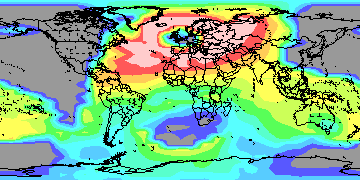
You can read my original posting here, but for a quick overview of when and where to work them from the UK see the chart above (right click and save it to view it full size). I'm giving a talk on propagation to T32C at the RSGB Convention at the weekend.


Tuesday, 13 September 2011

New "CW only" ship's radio room clock

For some time I have had a reproduction ship's radio room clock (and other items) for sale on Cafepress.com. You can read the full story about them here. I have had a few enquiries from die-hard former ship's radio operators asking if they could have a "CW only" version. These only had the red sectors at 15 mins and 45 min mins past the hour, when you had to go QRT and listen to 500kHz for emergency calls. Well, I've now reworked the artwork and you can order the "500kHz" clock at "The Radio Room" on cafepress.com.

Podcast: HF Propagation Report, September 2011


In this month's podcast I look at the effects of solar flares on the ionosphere - what they are, their effects, and how you can tell whether we have had one or not. Hint - the solar flux index and K index indicators won't help you! It lasts about 8mins.

Click on the headline to listen to the programme online or if you prefer to listen to it on your iPod search for G0KYA on iTunes.

Tuesday, 6 September 2011

The W5GI “Mystery Antenna”

W5GI's “Mystery Antenna” gets a lot of attention. Possibly because of its daft name. It looks like a G5RV, but W5GI (now SK) used coax stubs to give what he called “a coaxial colinear array on 20m”. It consists of a half wave length (at 20m) of 300 Ohm ribbon that feeds a dipole centre. Either side of the dipole centre are two pieces of wire 16ft 6in long.These are then each connected to the inner of a 16ft 6in piece of RG58 coax. The outer is left unconnected. The far end of this is then shorted and connected to a further 16ft 6in of wire, giving an antenna with a total span of 99ft. I've now been using one for about three months, so find out what I think of it, is it really a "mystery" and is it worth making one! Download the report. Update: I have been doing some more modelling with the antenna as an inverted V and if mounted at about 10m with the ends at 3m you'll find that the lobes vanish and it becomes pretty omnidirectional at higher frequencies. On 20m you may find it radiates best broadside to the wire and less off the ends - this seems to match what I have found. Plots for 20m and 10m Inverted V have been added to the report.
Further update: I have now included the original CQ magazine constructional info in the PDF. I can also confirm that the 50 Ohm resistor method I suggested to determine the exact half-wave electrical wavelength on 20m works a treat as I have just built another one.

Saturday, 3 September 2011

UK propagation charts for September 2011

Good autumnal condtions are coming. This is a good time for working north-south paths, such as UK to South Africa. Also, keep an eye on 21MHz and higher. With the solar flux index above 100 we are seeing some nice openings - have worked Nigeria, and heard Thailand, Japan, China and the US West Coast over the past few days on 15m. There have also been some good early morning (6.00-7.00 UTC) openings to Hawaii, the Pacific and the US west coast on 20m. Listen out for KH6s. Even 40m is looking good - if you don't mind getting up early. It has been open to the Caribbean and most of the US at 4am UTC - I have to get up early on Fridays anyway to get an early train! Have even heard WWZN Boston on 1510kHz medium wave on a 100ft W5GI dipole Anyway, good DX and 73. Go to the propagation charts