Showing posts with label QRP. Show all posts

Sunday, 7 January 2024

Help needed with Index Laboratories' QRP+ radio

I need your help! 

But first some background. The Index Laboratories' QRP+ is a 1990's 5W all-band QRP transceiver from the USA. I bought mine at a club sale and it was supposed to be working fine.

But it wasn't! Never mind, we all love a
challenge, don't we?

It seems that the SBL-1 mixer is a common failure point so a replacement was ordered.

The rig comprises four boards, which are stacked and have interconnecting leads.

It is relatively easy to pull apart, and the mixer is on the top board.

After a big desoldering struggle I fitted the new SBL-1 (U5), which brought the receiver back to life. Unfortunately, the TX still didn't work. Back to the drawing board.

The next stage was to replace the final PA transistor, which is on the lowest board. This is a IRF510 (Q9) and I ordered a few off Ebay. I fitted a new one and in tests I found that I could only get about 0.1W out! (on CW) with the gate bias backed off fully anticlockwise. 

Power out should be about 5W.

Anyway, that's as far as I have got. I have attached a link to the circuit diagram and would appreciate any suggestions.

Update

Well, some replacement IRF510s were sourced from the G-QRP club (thanks guys). Apparently, there are some "fake" IRF510s around that don't play well with RF.  After pulling the radio apart (again) and replacing the transistor, it was a little better - about half a Watt output. Anyway, to cut a long story short I have passed the radio to another G-QRP club member and I hope he has more luck than I did! 

Sunday, 10 March 2019

2019 Commonwealth Contest and QRP

My Yaesu FT-817 and Winkey

This weekend has seen the Commonwealth Contest 2019. I documented my 2018 attempt on the blog, and was keen to give another go this year.

Last year I used my Icom IC-756 Pro 3 wound back to 5W, but this year decided to use my Yaesu FT-817 for a real QRP approach. I bought a USB lead for it this year to give full computer control with N1MM and decided to use my Winkey for full auto CW .

This year I had a slight change to my antennas. Out went the end fed half wave (with 80 loading coil) and in came a 66ft OCFD with the apex at about 8m. Also new was a quarter wave vertical for 20m, erected for the weekend on a 10m fishing pole - more of that later.

The contest ran from 10am, but at 9.30am I was struggling with the computer and interface. Stupid me forgot to turn off the keyer on the FT817 - duh!. Soon we were under way.

The contest got off to slow start with my 5W struggling to break through. Many stations just couldn’t hear me. The quarter wave vertical for 20m turned out to be a noise magnet - almost S8. I  decided to abandon it quite quickly.

After an hour I had a few stations in the log - 5B4AGN (Cyprus) and 9H1CG am (Malta), but nothing better. 3B8XF Mauritius (G3TXF) was audible, but I couldn’t break through. Same with ZF2CA Cayman Islands (both 3B8 and ZF were worked last year).

The afternoon saw Canada romping in and I ended up doing an hour at about 10-11pm, clearing up the UK HQ stations.

Sunday started at about 5.30am and a few more Canadians on 40m were cleared up. I then had a big breakthrough - VK4CT on 40m. It wasn’t easy, as they needed three or four repeats on their serial number, but we got there eventually.

So there you go - 34 QSOs in total, which doesn’t sound much, but I didn’t take part for the full 24 hours and it is HARD work with only 5W. Peter M0RYB, a fellow Norfolk Amateur Radio Club member, cleaned up with 70 QSOs in the QRP section. Must find out his secret!

Note: The FT-817 isn't much of a contesting radio. I found it struggled with a nearby 400W station and also found the 500Hz filter a bit too wide. Might be back to the IC-756 Pro next year.

Thursday, 1 November 2018

Autumnal HF conditions show sunspots aren't everything

Click to enlarge

Don't you just love it when something works! I took down my multi-band end fed half wave (EFHW) antenna last weekend and replaced it with a home-made 40m off-centre fed dipole (OCFD).

The EFHW worked, but I was never happy with the performance. This may be due to the inverted L configuration or the compromise 49:1 ferrite-based Un-Un. Either way, I felt I was missing out on some DX and was keen to try something else for the Autumn/Winter.

The 40m Windom is about 66ft long and has a home-made 4:1 Guanella balun made with two ferrite cores. It is fed at the 41%/59% point so it covers 40, 20, 15 and 10m with an SWR below 3:1 and the other HF bands with an ATU.

The apex is at about 8m with the ends down to about two metres, so not ideal.

Nevertheless, in back-to-back WSPR tests it proved to be better than my W5GI dipole that goes over the roof by about 7dB on average. This was good as the EFHW was mostly down on the W5GI.

Anyway, I thought I would leave it running on 20m WSPR for 24 hours to see what it could pick up. This was with zero sunspots, but a Kp index of 1. I was delighted to see that I had been picked up as far afield as Japan, Australia, Alaska, Antarctica and Brazil. The furthest west I got in the US was Utah.

So, I'm a happier bunny. I might return to the multiband EFHW one day, perhaps looking at different ferrite mix configurations for the Un-Un, but for now I'll stick with monoband EFHWs with tuned iron toroid/capacitor matching units that work well.

The OCFD can stay up for a while - you know that the best antenna you can have is either the one you just took down, or the one you are going to put up, not the one you are using!

Tuesday, 19 June 2018

Fixing the 20m QCX radio


I've had my 20m QCX kit working now since just after Christmas. While the build was quite straightforward I did have a few problems.

Click to enlarge the photograph by the way.

The first was that I managed to blow the 7805 regulator while leaving the radio running on WSPR one morning. Having replaced that I found that the rig was quieter and there was no TX output any more. Thinking I had also blown the PA transistors I replaced all three of the BS170s, but that didn't help either.

Anyway, after a lot of help on the QCX reflector I decided that the fault had also taken out the 74ACT00N chip. This had been soldered onto the board directly so had to be cut out with a Dremel and a new IC socket installed.

And after finding a short somewhere near the PA transistors all was well - success! Output using a 12.6V Lithium battery pack was about 1.8W

I have been using it on and off ever since as it has a really nice receiver - even took it to North Norfolk as I detailed in another post.

But one thing always bugged me - why only 1.8W? When I built it originally I was getting more like 3W, so perhaps it was the replacement BS170 transistors, which came off Ebay on a slow boat from China.

So having a few hours free today I ignored my own "if it ain't broke don't fix it" mantra and pulled it apart. I replaced all three BS170s with new ones bought from the GQRP club and while I was at it I replaced C22 with a 0.1uF capacitor to try and soften the sidetone a little.

I managed to break one of the wires to one of the control buttons on the front in the process, but it is now all back together.

And the power output is now just under 3W with 12.6V - success! I have no doubt I could get more if I messed around with the band pass filter, but I don't think it is worth it. I tend not to run it on 13.8V as the regulator gets VERY hot indeed.

Anyway, it is a great little radio and will be going on some more journeys no doubt.

I can thoroughly recommend it as a kit project - see QRPLabs site. My case came from Banggood in China and only cost  a few pounds. It did take about 10 hours to machine (posh word for drilling out with a Black and Decker and attacking it with a file).

The label was produced in Photoshop and printed off by Photobox.co.uk. I ruined the first one by spraying it with varnish, which made the dye run. Luckily I have a few more spares and may eventually cover one in sticky-back plastic. But for now it looks great.

The red buttons were bought just before Maplin went bust so are a lasting tribute to what was one of my favourite shops and the result of much ribbing by the family every time I went there - RIP Maplin.

Thursday, 24 May 2018

"Bumps on the Air" 2018 - QRP in North Norfolk, UK


Today was 2018 ”Bumps on the Air” day for me. Because we don’t have any summits in Norfolk I have to make do with tiny hills, or bumps!

Two years ago Jim G3YLA and I climbed up Beeston Bump (63m) and did some amateur radio operating. This year I wanted to beat that so drove to Norfolk’s mightiest peak – Beacon Hill near West Runton at 103m. Ta dah!

Actually, this wasn’t a very exciting spot as there are just two rotting benches, a flag pole and trees all around.

Nevertheless, I set up my end fed half wave vertical on a 10m fishing pole and connected up my Yaesu FT817. There wasn’t too much about but I worked John F5VKU (also G8MM) near Cannes with 5W SSB. He said he was struggling to hear me.

My 20m QCX radio - click to enlarge any image.
After playing with SSB for a bit and failing to break some pile ups I connected up my 20m QCX radio and tried some CW. I was really surprised as Karl IV3RJH came back to me, 559/549 both ways. I was running about 2W, he was running 3W.

I do have to fix the sidetone on the QCX as calling CQ sounds more like “thump-de-thump-thump-thump-thump-de-thump”. I have the new capacitors, but am waiting for some new BS170 transistors so I can hopefully up the power level to more like 4W too.

But the QCX is an amazing radio for the money and hey, I built it myself, complete with the case and custom label, so any QSO makes me smile.

Another 20m SSB session with the FT817 and I bagged Jack OH3GZ and Juha OH6QAZ.

At this point I packed away and after lunch headed for Beeston Bump on the coast near Sheringham. I’ve written about this before as it has a fantastic view over the North Sea.

Anyway, I put up the EFHW vertical for 20m and set to with 5W CW from my Elecraft K1. This raised Gert OH/DL7UG and Dima RW4C. I then bagged Fabi IK5IiS near Florence.

Also heard were stations in Cypus and Canada, but the Cyprus station on SSB couldn’t hear me and the Canadian seemed to be sending his life story in CW to another station and I got fed up waiting to call him!

I also had a play with my 3W MTR3, but didn’t work anyone as I could see rain clouds coming and decided to pack up.

So not a bad day’s radio. The Elecraft K1 and Yaesu FT-817 worked flawlessly. I think I was getting some RF into the keyer on the QCX as I had trouble sending “/P” – the “/” turned into a right mess sometimes, although I had no trouble sending it on the K1 with the same Palm Paddle.

The moral is that life is NOT too short for QRP!

Update: I checked the reverse beacon network last might and saw that I had been picked up across Europe while calling CQ, but often with no response. Some of these SNR figures are quite large too. In other words I was loud enough.

That's a shame as it would have been nice to have worked some more stations.

Is this because of a lack of activity? Or is it because, as I often wonder, that a lot of people have moved to FT8?

Sunday, 11 March 2018

Commonwealth Contest 2018 and QRP


RSGB certificate for 5th place QRP section.
Update: It turns out I came 5th in the QRP section of the 2018 Commonwealth Contest. I lost two QSOs for being "not in log",  and lost 4th place by 10pts to Dave G3YMC (which is how it should be!). Great fun and I'll do it next year, probably with my Yaesu FT817 and the addition of an EFHW vertical for 20m too.

I took part in the 2018 Commonwealth Contest this weekend on HF CW. This was always going to be a casual entry as I had other things to get on with over the weekend, not least was helping tidy the house for Mothers’ Day on Sunday!

I decided to enter the QRP category with a maximum of 5W. One reason was I knew that my good friend Dave G3YMC had won the category last year with 30 QSOs. I mean, how hard can it be to beat 30 Qs with 5W? Answer: very hard apparently!

I got going with 20m and quickly worked four stations in Malta and Cyprus. I also cracked off some of the UK HQ stations on 80m for 25pts apiece.

The afternoon saw openings to Canada, which brought in a few VEs. I was also happy to work the Cayman Islands and G3TXF on Mauritius.
My multiband fan dipoles in the loft.
Only used with QRP for EMC reasons.

Ionospheric propagation conditions were lousy with no sunspots and a geomagnetic disturbance the night before.  Fifteen metres was closed so it was a 80, 40 and 20m only event.

What you quickly realise is that many stations are using the full legal limit, so might be running 400-1,000W. If they aren’t very strong they probably won’t hear your 5W QRP station - fact of life!

So there were lots of “NR?” being sent for repeats, if they came back at all.

I went to bed about 23:30hrs and set to again at 06:45hrs. At that time 20m was dead, but there were some 40m and 80m contacts to be had and I managed to get VE in the log again. I also swept up the remaining G, GD, GI, GJ, GM and GW HQ stations as these were quite easy with 5W.

The antennas were my loft-mounted fan dipoles for 40-10m, which beat the outdoor multiband 80-10m end-fed half wave and W5GI dipole on 20m - go figure. I used the EFHW or W5GI for 40m and 80m, depending on which gave the best signal.

The “nearly” category included QSOs with Singapore, Australia, Gibraltar, New Zealand and Zambia - I just wasn’t loud enough. But hey, Cayman Islands, Canada, and Mauritius on 5W will do me!

Next year if I do it again with 5W I might put up a monoband 20m EFHW and perhaps use my Yaesu FT-817 (I don’t currently have a CAT cable for it), although the IC-756 Pro3 band scope is handy and it is an excellent rig, even when backed off to 5W. Logging/keying was with N1MM+, which worked flawlessly.

All good fun and 30 Qs won’t win it ( the highest QRP entry so far is C6AKT with 92 QSOs), but my unconfirmed overall score was higher than the 2017 winner’s, so not too shabby.

The Commonwealth Contest is a great one-weekend opportunity for UK stations to work DX with no big pileups.

Thursday, 6 July 2017

CW fun with the Elecraft K1

I haven’t had much of a chance to get on the radio recently – the day job has been getting in the way!

So I thought I would put my Elecraft K1 into action yesterday evening and see what could be done with 5W of CW. I built this rig last year after having the kit in the loft for about 12 years – you can read about that here.

The great thing is it only has two bands 20m and 40m. This focuses the mind and stops you QSYing to other bands left right and centre.

So, I hooked up to a W5GI dipole and a 65ft EFHW (with loading coil for 80m too) and switched on.

The first station worked was OZ7BQ, Joe near Copenhagen, on 7.026MHz. I had to double check his name as it shows on QRZ.com as Hans Jørgen, although he definitely sent “Joe”.

Then it was IQ7AF on 7.028MHz, a special event station in Southern Italy.

Joe OZ7BQ
Staying on 40m, I narrowly missed Mike GM0HCQ/MM on the James Clark Ross, a research ship just off the coast of Norway and heading for the Arctic.

Then it was on to II2FIST on 20m, celebrating 30 years of the FISTS CW group. Managed that on first call despite a pile-up – not bad with 5W.

And to round the evening off I made contact with Doug ZP6CW in Paraguay on 20m. Other countries heard but not working included Norway, Serbia, Germany, Russia and Czech Republic.

This isn’t to brag, just to show what you can do with 5W CW from a kit-built rig and a compromise antenna. All the 40m contacts were on the home-made W5GI dipole. Half of the 20m ones were with the multi-band EFHW.

I think 5W SSB would have been a different story.

Wednesday, 24 May 2017

Soda Pop 40m CW QRP radio now finished

The finished 40m Soda Pop QRP radio (click to enlarge)

I finally finished the 40m 5W Soda Pop CW radio by Steve Weber KD1JV.

Building the board took about 8.5hours. But preparing the hardware from scratch took a lot longer.

I used a Hammond die cast box and drilled the hole for the controls. I then chain drilled, cut and filed the aperture for the display. My metalwork skills are limited to what I can do in the garage with a Bosch drill and a selection of files.

I ended up having to elongate the holes for the controls and turn the hole for the antenna connection into a slot, otherwise I couldn't get the board in at the angle required. As a result I had to make up a plastic blanking plate for the back.

The box was painted with Plasticote metallic blue and gloss varnish.

The finished 40m Soda Pop QRP radio (click to enlarge)
The panel label was produced using Photoshop and a photograph of mine of Happisburgh Lighthouse in Norfolk (we don't have any summits as it is very flat!).

Once I was happy I then used Photobox to produce five copies of the photograph (in case I screwed a few up) and lacquered that too.

The whole thing was assembled after the front panel was stuck on with red Spraymount.

I'm happy with the result, although I might do the front panel again at some stage to get the hole alignment a little better and also lacquer it with a matt rather than gloss varnish.

Things I learned:
1. Metal cases take a lot of work to get them right!
2. Measure, measure and measure before cutting and filing.
3. When chain drilling, make the aperture too small at first and open it up with a file.
4. Choose a dust free spot to do the painting - a dusty garage floor is not ideal
5. Let the paint harden for about a week to avoid fingerprints.

Now, the fun can start and I can use it a bit more.

So far I have worked Italy, Ukraine, Poland, Germany, and Estonia with it. Many thanks to Steve Weber KD1JV for a great little design.

I'm planning a Norfolk "Bumps on the Air" (BOTA) outing with it quite soon.

Steve G0KYA


Tuesday, 9 May 2017

Soda Pop 40m QRP Transceiver S/N 011 lives!

The board for the 40m Soda Pop QRP radio (click to enlarge).
I was lucky enough to get my hands on a Steve Weber KD1JV-designed Soda Pop single band QRP CW transceiver kit recently. Soda Pop is meant to be a play on "SOTA Op" as it is meant to be a lightweight portable radio for "Summit on the Air" operators

Steve only produces a design every two years or so and they instantly become classics. It is a lottery as to whether you are lucky enough to get one and this time I was. My other KD1JV rig is a 3-band 3W Mountain Topper Radio, which I built myself (you can now buy them ready made via LNR precision).

All of Steve’s rigs are fantastic, tricky to build as they are nearly all SMD, but offer fantastic performance. You can blame Colin M1BUU for getting me into these. Colin’s Steve Weber rigs are works of art and regularly go up mountains for SOTA.

As I live in Norfolk (which is very flat) I have to make do with the odd hill!

I’m happy to report that my 5W 40m Soda Pop rig is now built and working well. 

Built using hand soldering over a period of a few days – a total of about 8.5hrs – I was delighted to find it worked first time. Sensitivity seems good and power output is 5.1W with a 12.3 V Li-Ion battery.

I aligned it by ear as I don’t have an oscilloscope and got it close. It was perhaps 20-40Hz off frequency, but a quick tweak in the calibration mode got it pretty much spot on.

Note the tiny SMD components - all hand soldered
(click to enlarge).
The BFO was setup by ear too.

So did the build go without hiccups? Hell no! The following points might be useful to other builders.

1. As always with SMD take great care with the components. Transistor Q14 “pinged” off at one point never to be seen again, or so I thought. As luck goes, I found it three days later under a desk lamp - 10 minutes after I had ordered a replacement off Ebay!

2. Follow the instructions religiously and only take out the components one at a a time. This saves them getting muddled up as many have no markings.

3. Take extra care with the band-specific components as it is easy to get it wrong. I ended up mistaking some inductors for the capacitors and had to remove them. If in doubt check them with a multimeter to make sure they are inductors and not capacitors. This may be why some people are reporting deaf receivers.

4. When you do the initial alignment and are peaking CT1 and CT2 make sure you have actually turned the volume up. Doh! Even with the volume turned down you will hear a hiss, which you may mistake for band noise. Don’t ask me how I know!

5. Note that not all the component locations are actually used, including C10, C49, C59, C6 (on some bands) and D2.

6. As you identify components  bag the spares up in marked bags as you will need some of them when you build the top of the board.

7, When soldering the power socket make sure it is square to the board - mine had twisted slightly and had to be de-soldered and done again.

8. Make sure you have the right number of turns on the two T39 toroids. Putting the wire through the hole counts as one turn. 

Anyway, it is early days for the Soda Pop - the 40m band was in lousy condition today and there were only a few signals on, but they seemed about as loud on the Soda Pop as my IC-756 Pro3. I’ll try it again tonight when the band should be better.

The RBN shows I was being heard in Germany and
Scotland on 7.030Mhz
A CQ call on 40m resulted in me being heard by DF7GB, DJ2BC, DJ9IE and GW8IZR via the Reverse Beacon Network at up to 20dB SNR at 13:50UTC. 

The hardest bit now will be boxing it up - I have a Hammond 1550M Die Cast Box, but that will need some serious metalwork (cutting, drilling and painting) so it will no doubt take longer than the build-up of the board.

I’ll add a photograph as and when it gets done.

My thanks (again) to Steve "melt solder" Weber, KD1JV.

Steve G0KYA 

Monday, 2 January 2017

Some Christmas QRP HF operating

Elecraft K1 on 40m QRP frequency.
The period from Christmas to the New Year is traditionally the time for the GQRP “ Winter Sports”.

I don't take this too seriously as there are plenty of other calls on my time, but it is an opportunity to get on the air and work a few stations with 5W CW or 10W SSB.

This year got off to a good start with a contact on 23rd December with SK6SAQ at Grimeton in Sweden – home to the Alexanderson alternator that puts out a 200kW signal on 17.2kHz.

SAQ also has a special event callsign so it was good to get operator Kjell in the log using 5W from a Yaesu FT-991 into an outside EFHW. I really must visit Grimeton one day.

I also dragged out my Bencher paddle as I was sending some awful Morse with my Kent single lever I think I was getting key bounce so will have to take a closer look. The Bencher was fine, which was good news.

After Christmas I turned to my Elecraft K1, which I finished in the summer after owning the kit for about 12 years!

This brought CW QSOs with Peter OM0WR in the Slovak Republic on 7.029MHz with 5W into my loft-mounted zig-zag dipole.

The YT160TESLA QSL card.
Then it was YT160TESLA on 20m celebrating 160 years since the birth of Nikola Tesla in Serbia. I really want their QSL card which looks great and worked them on 40m in March. As they went QRT at the end of 2016 it really was a last chance.

I have an Icom IC-7300 on test, which belongs to my local club and that brought 9A1700SBD in Dubrovnik, Croatia, although it took 25W to get through.
The view across the rooftops of Dubrovnic, Croatia.

2016 was the 1700th anniversary of St. Blaise, patron saint of Dubrovnik – if you ever get the chance to go there, do as it is absolutely beautiful.

Station LZ463PP then went in the log with 10W from the IC-7300 and a W5GI dipole on 17m SSB, so still QRP. It was celebrating 463 years of Saint Patapii.

Finally I had a nice (but weak) QSO with Ian EA7JUK in Lubrin, Spain on 20m CW using 5W from the K1 and an indoor dipole. Ian's UK call is G0WHX.

The Reverse Beacon Network proved everything was working!
Sunday 2nd January marks the QRPARCI New Year's Day Sprint, but I really didn't expect to hear anything from the US due to rotten HF conditions. If I do I'll update the blog!

So, I heard a lot more stations than I worked, but I had fun – which is what it is all about.

Tuesday, 2 August 2016

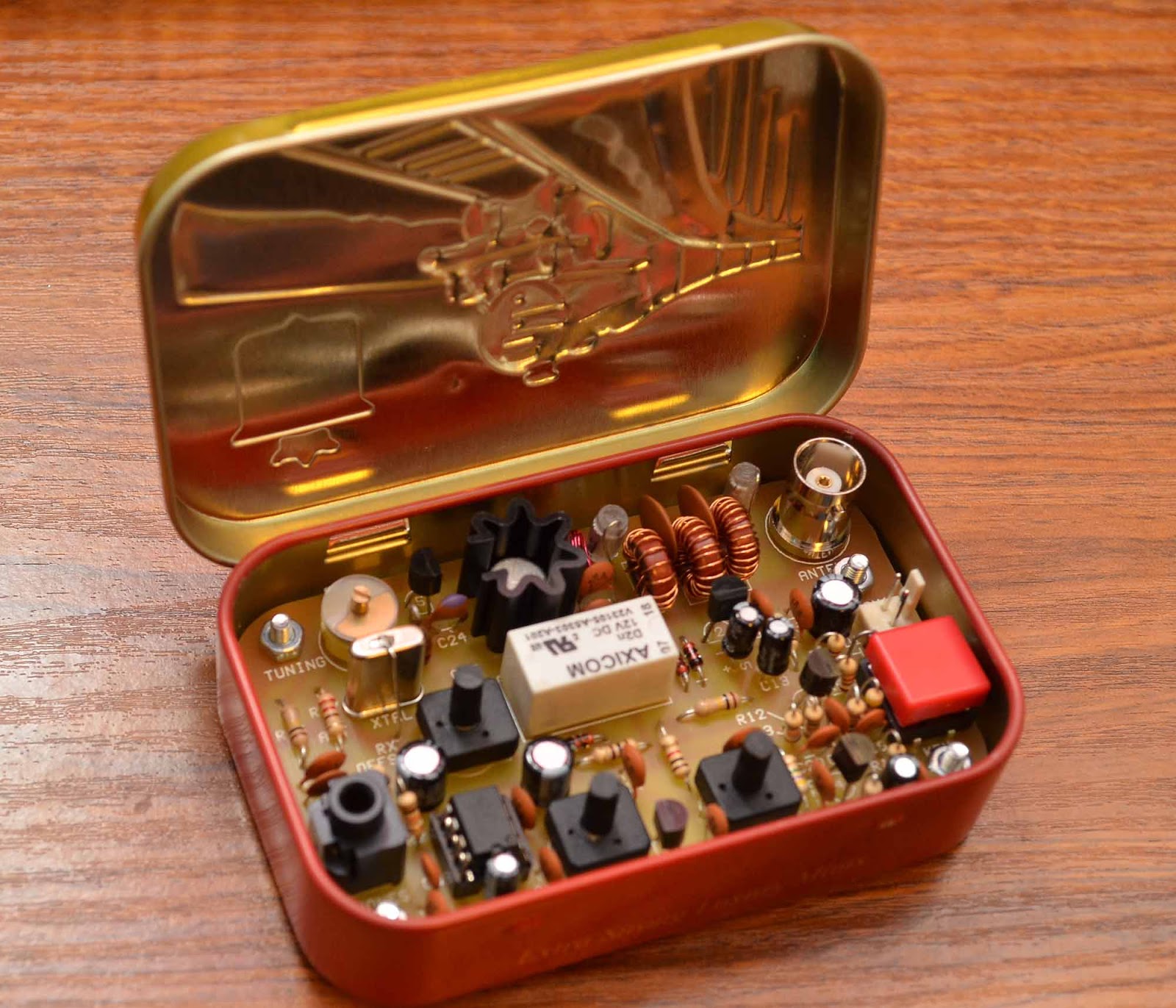
More great tins for QRP radio projects

Click to enlarge
Regular readers will know I've built a couple of QRP HF radios into mint tins. The first was a 20m Rockmite ][ built into a Stewarts' tin with a Spitfire on the front. 

The second was a 40m Foxx-3 built into a Stewarts' train tin.

This all came out of a desire to build something in an Altoids tin or similar having been inspired by the fantastic radios built by Colin M1BUU.

He showed me a Steve Weber-designed ATS (Appalachian Trail Special) in an Altoids tin at a Rishworth QRP convention and the workmanship was fantastic.

Anyway, both my radios work, but at around 1W or less QSOs can be quite hard work – must dig them out again soon and have another play.

But this has set me on the trail for more and better mint tins and I found a couple of crackers recently.

The first depicts the White Star Line and was bought for £3.50 at the Bressingham Steam Museum in Norfolk. They had other designs and it appears to be made by a company called Half Moon Bay in Bath. They are a wholesaler, but do have links to an online stockist – Kitsch-a-go-go – which has lots of different tins.

The second tin was found at the British Motor Heritage Museum at Gaydon and depicts an MGA sports car. It is also a little bigger than an Altoids tin and cost £4.

This was made by a company called Red Hot Lemon. It has a minimum order of £100 unfortunately, but you could always club together with someone else to buy some.

Now, all I need is another kit to build. What I'd really like is a 3W 40m and/or 20m radio transceiver, preferably synthesised so that you move around in frequency that would fit in a standard Altoids tin. So basically, a Steve Weber ATS or MTR – shame they are not being made in kit form. I have a three-band MTR v2 which is my pride and joy.

If you know of any other suitable kits please let me know by commenting below.

Thursday, 28 July 2016

Repairing a cross-needle SWR meter

The SWR meter - working 100% again.
I've owned an AEA ET-1 antenna tuning unit for the last 20+ years. In that time I've had to replace the inductor switch as it burned out and also replace the meter.

Luckily, it uses exactly the same meter as MFJ ATUs so I was able to buy a replacement from them. I also resprayed the case at some point.

But recently the meter started playing up – it would only indicate 20W maximum forward power instead of 100W.

It was more of a problem on the less than 30W setting as I often use QRP radios and need to know if I am putting out 2W or 5W.

You could ask “why not just bin it?”, but that's not in my DNA!

Anyway, after asking for advice on the CDXC forum and looking at the schematic I decided that it could only really be down to a failed capacitor, resistor or diode. Given that semiconductors would be the first suspect I ordered two new 1N270 diodes from a UK supplier on Ebay for £3.98.

When they arrived I unsoldered the old ones, and checked them – one measured 1K Ohm resistance in both directions – not good and definitely not diode-like behaviour.

I soldered in the new diodes and bingo the meter is back to normal again. I've since ordered some 10 more 1N270s from China for just £1.12 inc. postage. These will do as spares.

I'm writing this as it might be useful to owners of cross-needle SWR meters in future. If you start to get low readings it may be the diodes. If you get no reading at all it is probably the meter.

Friday, 22 July 2016

Elecraft K1 QRP radio finally finished

My Elecraft K1 (click to enlarge)

You could say that this project has been a long time in the making. The kit for this Elecraft two-band (40m/20m) K1 5W CW radio was actually a Christmas present back in 2004.

Heck, I still have the invoice for $329 plus the £44.97 import duty, making it about £230.97 at the exchange rate of the day (nearly £300 at today's rates).

When I first got the kit I had a couple of reads of the instruction manual, went “wooah” and put it in the loft. It even moved house with me eight years ago.

Anyway, a conversation with Colin M1BUU (a more enthusiastic QRP builder and SOTA operator you couldn't wish to meet) at the 2014 G-QRP Convention convinced me that I really should put it together.

In the intervening 10 years I have built a lot of other kits, including a Hunter SDR, Rockmites, MKARS 80 and a Steve Weber MTR, so I had picked up a lot of construction skills.

Last Christmas I actually started the build and, while not difficult, it was time consuming. Fast forward to July and I thought it was about time I finished it.

The build wasn't too bad, but I had a few problems, such as the wiring on the multi-turn pot for the VFO control – I thought the numbers on the side of the pot represented the numbers in the manual. They didn't.

I also managed to lose a couple of components down the back of the bench, which were subsequently found, and also couldn't find the insulating spacer for the power transistor – this I managed to improvise with insulating tape and fibre washers.

The final c*ck-up was missing out two capacitors, which meant the receiver didn't work at all. I'm glad I eventually managed to debug it without any help.

In all, I think I spent about 22-25 hours putting it together, but the end result is worth it.

The Elecraft K1 has a fantastic little receiver and a built in keyer and puts out around 7W if pushed. I have had a couple of QSOs with it so far and it is a very useable QRP radio.

I can thoroughly recommend it as a QRP project, although Elecraft have now moved on quite a way with the KX2 and KX3 - but then my K1 kit is 12 years old!

Tuesday, 19 July 2016

Operating QRP from Beeston Bump (TG14) in North Norfolk

Update: YouTube video now available

Jim G3YLA and I operated HF and VHF QRP from the top of Beeston Bump in Norfolk as planned today.

It turned out to be the hottest day of the year, so not exactly ideal. Nevertheless, after parking up and walking to the top we were met by a fantastic 360 degree view.

I quickly set up by 40m inverted L end fed half wave (EFHW) on a 10m fishing pole, bungeed to a bench and fed it with my homebrew EFHW matching unit, while Jim tried some CW on 2m from a little beam. He didn't get anywhere with that so switched to FM and had a quick chat with some locals on 145.275MHz.

Once the HF antenna was erected I handed Jim the coax and he set to on 40m CW and quickly worked a station in Germany using 2.5W from his Yaesu FT-817.

Jim G3YLA working Germany on 40m CW.
I meanwhile tried to see what I could work on 2m FM and could raise the GB3FR repeater across the water in Spilsby, Lincolnshire, but there was no one on it. I switched to GB3NB in Norfolk and worked John G8VPE.

I then took over on HF, but 40m was hard work and 20m was not much better. I eventually went back to 40m CW using my 2.5W Steve Weber-designed Mountain Topper Radio (MTR) and raised fellow G-QRP club member Peter G3XJS near Wrotham, Kent who was using 5W to a doublet. I was very pleased to make the contact as that was the first time the MTR has been used in the field.

Looking at the Chilton Digisonde data I think this was via Sporadic E (Es) on 40m as the F2 critical frequency was only about 5MHz - we don't normally associate Es with 40m, but you could see the Es on the plot.

Jim G3YLA then took over again using his FT-817 and had a long CW QSO on 40m with a station in the Netherlands. 

The information board for the Y station.
There were a lot of walkers on the hill and we were able to explain what we were doing - it was quite apt as this was the location for the Beeston Hill Y Station, a secret listening post during World War Two. The chain of Y stations were on the front line, feeding Enigma intercepts to the War Office’s Bletchley Park.

There is an information board all about the Y station and the concrete foundations are still there.

Propagation was iffy at best and the heat was getting to us, so we decided to take the station down and head for the nearest pub for fish and chips and cold refreshments.

My home-made EFHW matcher and SWR
 indicator.
All in a great day and we both agreed we'll go back, perhaps in late September when propagation is better and the temperature is a bit more reasonable.

I also shot some video and I'll try and edit that over the next few days.
My three-band (40, 30 and 20m) Mountain Topper Radio.
3W CW on 40m raised Peter G3XJS in Kent.

Update:

I thought I would do a Reverse Beacon Network (RBN) check tonight.

I was pleasantly surprised to see I was picked up all over the place, including the US, from the top of the bump.

Jim G3YLA wasn't for some reason - not sure why as his CW is waaaay better than mine. Perhaps it was because he responded to CQs and didn't call CQ himself.

Reverse Beacon Network captures from the day -
chuffed I was picked up in the US (just) with 2.5W to an EFHW for 40m (click to enlarge).
Update: YouTube video now available

Saturday, 16 July 2016

G0KYA to operate a "BOTA" station - "Bumps on the Air"

Beeston Hill near Sheringham in North Norfolk.
Image Wikimedia/Stavros1
I plan to operate QRP from Beeston Hill in North Norfolk on Tuesday 19th July as part of a new "BOTA" activation.

BOTA stands for "Bumps on the Air" a wholly-fictitious new organisation for radio amateurs who don't have access to real summits and mountains.

Beeston Hill (known locally as 'Beeston Bump') is not the highest point in Norfolk, but at 63m (207ft) above mean sea level it offers a good view of the coast and excellent HF take off.

I wanted to have some outdoor local QRP SOTA fun, but Norfolk is a little short of suitable summits (well, none actually) and Beeston Bump will have to do.

The highest point in Norfolk is nearby Beacon Hill at 103m (338ft), but I don't want to overstretch myself! Anyway, the view is better at Beeston and there are more ice cream shops nearby.

I've been meaning to do this for years!

Beeston Hill Y station circa 1940.
Image; Wikipedia.
I plan to operate 40m and 20m QRP CW using one or more of a variety of commercial and kit-built radios, including a Yaesu FT-817, Elecraft K1, Mountain Topper Radio (MTR) by Steve Weber KD1JV and a 1W Rockmite. Antennas will be end-fed half wave (EFHW) dipoles.

Beeston Bump is no stranger to Morse code. Beeston Hill Y Station was a secret listening post located on the summit during World War Two. The chain of Y stations were on the front line, feeding Enigma intercepts to the War Office’s Bletchley Park.

There are no awards for working me on Beeston Bump, no certificates and no special QSL cards - just my normal one. And just the fun of working CW at about 16-20 wpm around the usual QRP watering holes on 20 and 40m. I hope to be there from about 10:30am.

Jim G3YLA, a fellow QRP enthusiast, might be with me too.

(With apologies to the excellent Summits on the Air (SOTA) organisation!)

Sunday, 21 February 2016

Worked All States, QRP and magnetic loops

MFJ-1786 magnetic loop for 30m-10m
This weekend was the ARRL CW DX contest where US stations work the rest of the world. This was a good opportunity to try and work the rest of the states I need for my Worked All States award.

I need Alaska, North Dakota, South Dakota, Wyoming, Rhode Island, West Virginia and Nebraska.

I have actually worked quite a few of these, but those stations are not on Logbook of the World (LOTW).

Anyway, starting at the bottom of 14MHz I soon came across KI1G in Rhode Island and bingo! He was in the log with 100W to the OCFD.

I never found any of the other states I needed, but on Sunday I came across N8II in West Virginia and bingo, worked him too. Unfortunately, he isn't on LOTW – damn! I'm not sure if you can do a mixed entry with part LOTW and part QSL cards, like I did with my DXCC application. It might come to that.

Anyway, with no sign of the Dakotas or Nebraska (don't even mention Alaska), I thought it would be fun to try some QRP.

With just 5W I soon worked Connecticut, Pennsylvania and Massachusetts with the OCFD. Time to up the game.

So I rigged up my MFJ-1786 mag loop on a 12ft pole in the back garden. This was about two S points down on my usual 40m half-wave OCFD, but I was able to work the eastern states on 20m in very short order. I also worked N2IC in New Mexico, W2UP Colorado and N9RV Montana on it.

So what about QRP and a magnetic loop?

A bit harder, but North Carolina, Tennessee, Vermont and Virginia were soon in the log with 5W on 15m.

Now, don't get me wrong, it is the antenna at the other end of the contact that was doing all the hard work, but if anyone says they haven't got room for HF antennas tell them about the MFJ-1786. It's a miracle for hams with little space.

So I'm hoping that Rhode Island gets confirmed on LOTW. I then need to think long and hard about Alaska. That is going to be a tough one. And if I can get the others confirmed with QSL cards Worked All States (WAS) is a possibility.


Monday, 21 December 2015

Rockmite 40m fixed and working

I unearthed my 40m Rockmite that I built years ago for a QRP session today.

First problem I noticed was that it wouldn't work with a paddle, only a straight key. The second was that I only had audio from one of the ear buds.

I thought this was a dirty connection so tried cleaning the contacts – no good. Turned out to be a poor joint on the back of the 3.5mm socket. In fact, I'm amazed it ever worked at all!

Now on to the problem with the paddle. The Rockmite will default to straight key mode if you fire it up with a straight key attached and that should have been the clue.

Pulling the front panel off I could see that the quarter inch socket for the Morse key/paddle had rotated and was shorting out one of the contacts that would normally go to the middle of the plug.

The Reverse Beacon Network proves you are getting out!
Once that was sorted the keyer burst into life. Connecting the Rockmite up to a W5GI dipole and sending a few CQs showed that I was being picked up all over Europe with about 0.75W (I normally send “1W” as it is easier).

Anyway I answered a CQ call from DF1UQ QRP he came back to me – wonder of wonders. I gave him 559 and he gave me 529. Turned out Klaus was running 4W. There was a lot of QRM from other stations in the late afternoon so I kept it fairly short, but the Rockmite works again.

I still think the sidetone is a bit harsh, but there is a mod for that if I was that bothered. You'll also see that I have a knob on the front that says VXO. This was an attempt to connect a variable capacitor in line with the crystal to allow me to move the frequency a little. All I got was hum so I abandoned that – one day I'll have another go.

I still think the 40m Rockmite has an amazing receiver for its size and price. The newer ones from Kanga UK/QRPMe are even better. It is definitely better than the Foxx-3, although that is self-contained. Both nice QRP projects to build though.

I'm trying to clear the decks of QRP projects/repairs so that I can concentrate on building my Elecraft K1 kit that was a Christmas present in 2004 – about time it was built I think!

Update 31/12/15
Just replaced C8 with a 0.01uF capacitor and that has quietened down the sidetone volume a little. Also put a 6.8mH choke in line with the crystal and small polyvaricon and am getting about 2.5kHz of swing around 7.030MHz which makes it a little more versatile. This was at the end of the crystal nearest Q2.

Wednesday, 16 December 2015

20m Spitfire Rockmite is joined by 40m FOXX-3


The 40m Foxx-3 - the big red button is the Morse key.
Click to enlarge any image on this page.
Back in July I wrote about the 20m Rockmite I built into a Stewart's mint tin. Well, now it has been joined by a 1W 40m FOXX-3 transceiver, also from Kanga Kits in the UK, but this time we have a steam locomotive on the lid.

The Foxx-3 is a well-known design that has evolved from George GM3OXX's original Foxx into its latest “-3” incarnation, designed by Derek G4GVM.

I won't go into how it works – you can find out more on the Kanga web site.

The build was quite easy – the first thing to do it drill the mint tin for the PCB stand-offs and open up the holes with a needle file. I used the PCB as a template for that.

The build sequence has good documentation, all the stages are in different bags and you can test each stage as you go.

The first stage to build is the audio amplifier with an LM386 and you test that by touching the volume control connection and seeing if it hums – no problem.

The second stage is the keying circuit, which again is easy to check. I opted for the push button Morse key on the board rather than a socket for a Morse key as this is really just a toy for me.

A slight amount of switchover delay is set by the value of a resistor. I stayed with the suggested value and that seemed fine.

The third stage is the sidetone circuit, which once again worked first time.

Stage four is the crystal oscillator and I had an issue here that when I keyed up the TX note was very wobbly. I read elsewhere that this can be normal until you build the final stage to give it a decent load. This turned out to be the case.

Testing testing!
The final stage is the power amplifier and filter, complete with four tiny toroids. Again, not difficult, but make sure you get the coating off the enamel before you finally solder the toroids in. I used a drop of molten solder on the iron to do this and it seemed to work OK.

The final stage was to put the BNC on the board and I had to increase the temperature of the iron for this as it acts as an effective heat sink.

Finally, it was a case of wiring it up to a 12V lithium ion battery, connecting a a 40 OCFD antenna and headphones and seeing if it worked.

The power output was just under 1W so I left it as it was – you can change a resistor to increase/decrease the power level up to 1W maximum.

Well, the RBN picked it up even if no one came back to me.
Using my Icom IC-756 Pro3 I checked where it was transmitting and adjusted the variable capacitor to put it on 7.030MHz. I then transmitted on 7.030MHz on the Pro-3 to adjust the sidetone offset. I found that this had a limited range before the receiver either went deaf at one end of the range or just hummed at the other. I did quite a bit of to-ing and fro-ing until I was happy – you'll see that one of the skimmers logged me on 7.0299MHz as I adjusted it.

I think that once it is set it is best to leave it.

I also found that I needed to use my ATU to avoid AM breakthrough on my W5GI dipole – the 40m Windom was OK. I had been warned about this.

The finished item in a Stewart's mint tin.
A few CQs using the built-in Morse key had me spotted on a few RBN skimmers in Europe. You can see that my reported speed varies from 13-15wpm as it is very hard to be consistent with a push button Morse key! It is also hard to send the highly-accurate Morse needed for skimmers to decode you, so I was pleased to be picked up in the UK, Ireland, Belgium and Germany during the daytime.

The reported 15-20dB SNR means it should be possible to work people with 1W, although no-one has come back to me yet and I haven't heard anyone call CQ who has been spot on my frequency.

The receiver is reasonably lively and you'll hear anyone who can hear you I guess.

The only issues were mechanical – make sure that when you put it in the mint box that you have enough room for the BNC plug to fit. I need to open up the holes on the PCB board by about 0.5mm to allow space for it to be connected. Doh!

I also had to grind down the three controls on the variable resistors to allow the lid to shut properly.

In all then, the Foxx-3 is a great little kit to make and it obviously works. Don't expect Elecraft KX-3 performance though! It only costs £29.95.

I do think that you will work other hams on it though, at least on the 40m version, and my thanks to Dennis at Kanga for selling it. The next project is an Elecraft K1 kit that I bought back in Christmas 2004 and has been living in the loft unassembled ever since. Shame on me!

Incidentally, the tiny zip-up nylon camera cases for sale in Poundland are ideal for storing and carrying mint box radios like the Rockmite and Foxx-3.


Thursday, 9 July 2015

New "Spitfire" 20m Rockmite ][ QRP CW transceiver is born

Click to view larger image
I was walking around a local shop recently when I spotted a range of mints in tins from a company called Stewarts.

They are very attractive and feature paintings of a Supermarine Spitfire, a steam locomotive and a Triumph motorcycle.


At just £2.99 each the tins are cheap and cheerful, and I knew just what I wanted to do with one!

Hence, the plans for a 20m Rockmite ][ transceiver were born.

I have built a 40m Rockmite v1 before, which is a crystal-controlled ham radio transceiver offering about 0.5W output on two very close frequencies – you select each one by pressing a button. The Rockmite also has a built-in CW keyer with a speed control and is a very simple, but well-respected little radio.

The joy is they will fit in a mint tin, such as the famous Altoids. But the Stewart tins are much more attractive.

So, I ordered a 20m Rockmite ][ from Kanga kits (www.kanga-products.co.uk) in the UK (they are actually made by Rex Harper of QRPme.com in the US) and it arrived the next day.

The box is easy to work on as the material is very thin. I carefully took the lid off while I was working on it and wrapped the rest in masking tape to protect it and allow me to drill the holes. Quick tip – run a pencil around the lid when it is closed so that you can see on the tape where the lid will be when it is assembled. You can then measure and drill the holes for the antenna jack, power, key, headphones and frequency switch knowing that they won't bind on the lid.

Click to view larger image
I used a sharp, new 2.5mm drill for all the holes after marking them with a centre punch first. I then used a Dremel tool and needle files to open up the holes to the size needed. With hindsight I would have moved the PCB a little closer to the antenna side of the box to give more room, but I have now managed to put it all together.

The PCB build was simple, but I did end up with some spare components, which worried me! I didn't miss anything, so I thought they must be spares.

Dennis G6YBC of Kanga subsequently emailed and said: "Apologies if the spare parts (bits left over) confused you. I enclose all parts to complete the Rockmite ][ in either of ways that Rex explains i.e. with volume and speed control etc.

"This includes extra resistors for the various mods that he and Chuck have published. This includes the 3866 and 2N2222 transistors. All the above parts are part of the BOM as per the build instructions for Ver 3, but you also have to read the other sheets Rex publishes on his website."

I also had to modify the layout by cutting a track and adding a resistor, but that was easy.

I had the choice of a 2N2222A (TO-18) transistor or a 2N3866 (TO-5). I chose the latter as I presumed it would give a higher output – wrong, as we'll see later!

I also swapped the BNC for a phono socket to match the Mountain Topper Radio (MTR) I also have, which I have written about before.

By soldering on all the connectors I was able to test if on the bench first before boxing to make sure everything worked, which it did (that's unusual for me).

Powering up the the Rockmite gives a “73” in CW through the headphones, which is a nice touch. You can switch to a straight key by holding down one of the paddles or the key on power up. You can also change the speed by holding the button down for more than half a second and then using either paddle to speed it up or slow it down – the speed in WPM is enunciated in CW.

The first tests were a little disappointing as summer afternoons are not the best for 20m. But the evening and next morning showed the little receiver is very lively, picking up stations in the US, Switzerland, Germany, Czech Republic and others with a dipole at about 25ft.

The rig is actually on 14.0604MHZ and 14.0598MHz as far as I can see.

So does it transmit? Yes, but only about 200-250mW with a 12.4V supply. I think the output can be tweaked a little higher, say 500-700mW by reducing the value of the R18 resistor, but I need to check on that.

Needless to say, I haven't managed to work anyone on it yet – it is a little too QRPP for me! I was picked via the reverse beacon network in Germany and Ireland though.

All in all though, it is a pretty little radio with a very nice receiver around the QRP frequency of 14.060MHz. Next step is a 40m FOXX-3 transceiver in the steam train mint tin I think.

Update 10th July 2015
I put a quick CQ out last night and was picked up on the VE2WU skimmer in Quebec. That's pretty impressive! 

Update 30th November 2015
I replaced R18 with a 3 Ohm resistor and replaced the output transistor with a 2N5109 and am now getting 500mW. Happy with that  

Saturday, 27 December 2014

A little post-Christmas HF QRP activity

Thought I would fire up my little three-band Steve Weber-designed MTR Mountain Topper radio for a bit of QRP fun this afternoon.

In a couple of hours I worked SP3JFK, 9A0QRP, OM5WW, HB9DAX and OK1DMP on 20m around the 14.060 MHz QRP calling frequency.

So that's Poland, Croatia, Slovakia, Switzerland and Czech Republic while running about 2.5W to a wire dipole at 25ft. More than happy with that!

What an amazing little radio.

On Monday 29th I thought I would give my Yaesu FT-817 an airing too with 5W CW and power from a small LiPo battery at about 11V.

Worked UR5AF, DK2BSN, S507PMC, KA5CJJ and EW7BW, adding Ukraine, Germany, Slovenia, USA (Texas) and Belarus to the total.

KA5CJJ was a tough one on 10m (all the others were 20m) as the band was closing. Allen was in Texas and running QRP too.

The FT-817 is another great little QRP radio.

Finished off the G-QRP Club Winter Sports on 31st December with my Icom IC-756 Pro 3 set at 5W with OF9X (Santa Claus SES in Finland), EA2BD/P (Ignacio in Spain), UT2QA (Peter in Ukraine) and TF3CW (Siggi in Iceland). Life's obviously not too short for QRP!