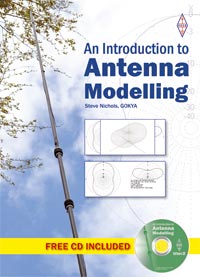
I am getting an increasing number of enquiries from people who are either buying or selling amateur equipment. Someone is using my name and callsign to scam people. It isn't just me - there are lots of examples of this now.
The scam is that the seller wants you to send money via Western Union, or will send a cheque (which subsequently bounces). Their English is usually quite poor and, strangely, I don't live in Nigeria!
If you are approached by someone purporting to be me please put a comment on this blog entry. I'm not selling/buying anything at this time.
Steve G0KYA
Wednesday, 19 January 2011

Friday, 17 December 2010
HF Propagation – December/January

G0KYA's propagation charts from UK for January 2011
This is the period when the low bands (160m, 80m and 40m) come into their own. The last two winters have seen great low-band propagation, with stations in the USA and Caribbean being worked on 80m well after sunrise. If you do nothing else keep an eye on 160m, 80m and 40m this winter as the relatively low levels of solar activity, the long winter nights and low D layer absorption means that DX may be heard all night long.
Band by band:
On 160m (1.8MHz or Top Band), solar absorption will prevent skip during the daylight hours. You should be able to work other UK stations out to about 50-80 miles via ground wave. The band will open around sunset and openings up to around 1,300 miles should be possible, with frequent openings up 2,300 miles. DX openings to the east from the UK should be possible around midnight and to the west before sunrise for well-equipped stations.
On 80m (3.5MHz), expect a similar pattern to Top Band with DX openings at night with peaks at midnight and around sunrise (greyline openings). Openings around the UK and out to around 500 miles should be possible during the day and between 750-2,300 miles at night. A low, horizontal antenna will be useful for relatively local, NVIS (Near Vertical Incidence Skywave) signals, but lower angle radiation, such as obtained with a vertical, will be required for DX.
Listen for DX from the West just before and just after sunrise – these are the months you are likely to hear US stations around 3795MHz in the morning.
40m (7MHz) is also another great DX band at this time of year. Forty metres should open to DX is an easterly direction during the late afternoon and towards the south at sunset. Paths during the afternoon may also include W6 (west coast USA) in mid winter. Openings to the west, including long path to VK/ZL should be possible after midnight and should peak just before sunrise. Relatively local contacts should be possible during the day, although low critical frequencies will mean that it is difficult to work other UK stations while perfectly possible to talk to European stations.
20m (14MHz) is likely to provide great DX openings during the hours of daylight. Peak conditions will be a couple of hours after sunrise for paths to the east and a couple of hours before sunset for paths to the west. Contacts up to 2,300 miles should be possible during daylight hours, but the band is likely to close to DX an hour or so after sunset. Occasional DX openings towards South America may be possible after nightfall.
17m/15m (18MHz/21MHz) should provide fairly good DX openings during daylight hours, although 15m may struggle to open at all on some days if the flux doesn’t rise above 80-90. The period from noon to late afternoon may be best, but both bands are likely to close at sunset and remain closed until some time after sunrise the following day.
12m/10m (24MHz/28MHz) may be good or bad depending on how the solar cycle progresses. If the flux stays in the 70s-80s there may be many days where there are no signals at all, although occasional brief openings to DX may be possible. If the solar flux heads towards the high 90s or more than 100 then good DX should be possible during daylight. A brief spell of sporadic-E can sometimes occur in the New Year resulting in very strong, but short-lived propagation on 10m out to around 1,300 miles.
A quick tip – if 28MHz seems dead listen to 27.555MHz USB which is a CB calling frequency. Activity there usually means that 10m may open up shortly after.
Stealth Antennas - now available in USA

My RSGB book "Stealth Antennas" is now available in the USA from the ARRL.
Tiny postage stamp-size gardens, intolerant neighbours, planning permission problems, living in apartments: these are some of the challenges facing the modern radio amateur when trying to get on the air. Stealth Antennas offers clear practical advice to those who might have thought they were unable to put up a suitable antenna.
You can buy it in Europe from the RSGB and in the USA from ARRL.
I'd like to take this opportunity to thank the many US hams who helped with the book by contributing their stories.
Wednesday, 17 November 2010
The EFHW - an efficient monoband end-fed half wave for 10m, 20m or any other HF band

Update: A detailed description and construction details are now available for download (PDF).
I like half wave dipoles. They are easy to make and easy to set up. They also perform very well and usually beat a compromise antenna hands down. With 10m about to come alive again as solar cycle 24 gets going what I wanted was a low-angle efficient radiator that could be put up and down in a couple of minutes.
My experience with ground plane verticals has been OK, but they are only as good as the earth beneath them. That is, they really need an extensive array of ground radials to work properly – not easy to put down when you are in a hurry.
I also like to use fibreglass fishing poles as antenna supports. These are available cheaply (I have a 7m version and a 10m version that I bought from Sandpiper at the Leicester rally). The only problem is that they don’t have lateral strength – they are good for supporting verticals, but not so good for half-wave horizontal dipoles.
What I really wanted to do was have a vertical half wave dipole, but the problem is that while the impedance at the centre of a dipole is about 50-75 Ohms, and very easy to match to coax, an end-fed half-wave has a very high impedance indeed, around 3000-4000 Ohms. If you just connect it to your coax or rig you will be disappointed.
Enter the End fed Half Wave as featured in my "Stealth Antennas" book - download the PDF for full details.
Update: now includes full construction details to download (PDF).
Sunday, 14 November 2010
NDBs (Non Directional Beacons) in the UK

If you fancy a bit of LF DXing, these frequencies might be worth a try. They are non-directional beacons and are used by aircraft. I searched high and low until I found this list, so thought I would share it. Some may now be off the air.
I can hear my local NWI (Norwich) beacon but that's it. They send their idents in fairly slow Morse code. Have a listen, especially at night
Tuesday, 9 November 2010
Understanding LF and HF Propagation ebook

In 2008/2009 Alan Melia G3NYK and I wrote a series of features on understanding LF and HF propagation for the Radio Society of Great Britain's (RSGB) "RadCom" magazine.
My features consisted of a month-by-month look at each HF band in turn, showing the reader the propagation modes behind each band and explaining some of the technicalities of ionospheric propagation.
I looked at the D, E and F layers, Sporadic E, the MUF/LUF, using solar data, propagation programs, NVIS and much more.
Alan then took over and wrote three detailed features on LF propagation. We are told that the features were well received and as a result I have managed to persuade the RSGB to allow me to put them together into a single document, which is now freely available for amateurs worldwide to download.
I hope you enjoy it.
Steve G0KYA
Download the "Understanding LF and HF Propagation" PDF (1mb)
Wednesday, 13 October 2010
More on the 20m EH antenna
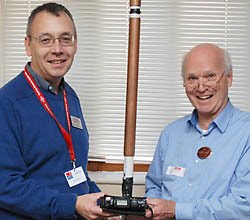
I recently attended a lecture on small antennas at the RSGB convention by Professor Mike Underhill G3LHZ (pictured on the right with me). Mike asked me to take my 20m EH antenna along (which has been featured on this blog) so that he could take some measurements with his miniVNA.
I set it up on a tripod in the seminar room and hooked it up to my Yaesu FT-817. What surprised me (and the delegates) was the fact that it was receiving signals from around Europe at up to S9 +20dB.
OK, a dipole could have done the same, but for a four foot antenna mounted on a tripod indoors that's pretty good. The antenna was built for my RSGB "Stealth Antennas" book (available now from RSGB and on their website soon) and has now been put back in my loft, where it happily offers a 1.4:1 SWR and signals that get close to my other antennas, sometimes beating them.
Say that it works by Poynting Vector Synthesis (PVS) and the experts go mad. But think of it as a short, fat dipole with a matching network and it still does the same job and everyone is happy ;-)
As one delegate said: "My friend lives in a flat and would love one of these".
Click on my link to read more or see http://groups.yahoo.com/group/eh-antenna/
UPDATE: "Stealth Antennas" now for sale on RSGB website.
Subscribe to:
Posts (Atom)