Wednesday, 31 August 2011

10m Slim Jim antenna

For dimensions see PDF
I can't take much credit for this. The original 2m Slim Jim was designed by Fred Judd G2BCX, who lived in Norfolk before he became SK some years ago.

This 10m one, made from 450 Ohm slotted ribbon cable from Moonraker and secured on an 8m fishing pole, was inspired by Jim Bacon G3YLA (also a fellow Norfolk ham) who brought one along to our annual “Radio by the Seaside” event.

It worked so well (beating a Rybakov vertical by about 6 S points) that I thought it needed more attention.

The result is attached - it took a lot of fiddling to optimise the length, cut out and feedpoint, but now you don't need to!

Tuesday, 23 August 2011

Working T32C from the UK

Update: Presentation download now includes comparison of predictions v actual as at 9th October.

The Five Star DXers Association are off to Christmas Island (Kiritimati) T32C in late September. If you want to work T32C it will pay to do a little bit of planning. In terms of the propagation to that part of the world there are a few factors we need to take into account.

The first question is “where is it?”. Kiritimati, or Christmas Island, is a Pacific Ocean atoll in the northern Line Islands - it should not be confused with an island of the same name in the Indian Ocean (VK9/X)!

The island lies 144 miles north of the the Equator and 8,400 miles from the UK

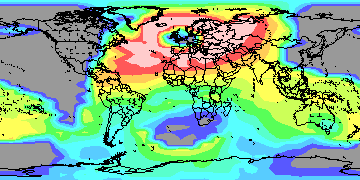
This highlights the first propagation problem – Kiritimati lies on a beam heading of about 335 degrees from the UK which puts our signals slap bang through the auroral oval around the north pole. Conversely, the long path heading of 156 degrees (and 16,400 miles) goes through the south auroral oval.

I have written a feature on propagation to T32C from the UK, which will appear in RadCom. I am also giving a talk on the subject at the RSGB Convention in early October.

In the meantime feel free to download a copy of the presentation, complete with notes, to get a feel for how hard (or easy) it is going to be.

Download the presentation in PDF format (1.4Mb)


Thursday, 11 August 2011

Podcast: HF Propagation Report, August 2011


A look at the last 30 days' solar and geomagnetic conditions and the link between sunspots and solar flares. Why you should use the smoothed sunspot number for prediction programs and how the Sporadic E season is coming to an end.

Click on the headline to listen to the programme online or if you prefer to listen to it on your iPod search for G0KYA on iTunes.

Tuesday, 2 August 2011

UK propagation charts for August 2011

Well, we are moving away from the summer solstice, but we are a long way from the better autumnal HF conditions that we should start to see in mid September. The summer sporadic E season should also be diminishing too. The last month or so has been characterised by big swings in the solar flux index and pretty poor conditions, although it doesn't pay to generalise. A chance glance at 17m a week or so ago showed a station from Los Angeles, calling CQ and with very few takers. He was about the only signal on the band! These charts are based on a smoothed sunspot number of 45. The SSN is what is recommended by the originators of VOACAP and might seem a little low, but it is supposed to give better predictions. Go to the propagation charts

Tuesday, 12 July 2011

The Wellbrook ALA330S active loop antenna


I have had one of the above to test. It is a 1m aluminium loop with a built-in preamplifier and covers 3MHz-30MHz with reduced performance on lower frequencies.

I was particularly interested in how it performed on LF and Medium Wave. Connecting it up in the shack (it has a BNC connector on the loop and a separate power supply that feeds 12v to the loop) I was initially disappointed as it seemed noisy.

But this is because my house is just buzzing with electrical noise. Putting it outside, even leaning against a tree, made a massive difference.

I was able to receive BBC Radio Wales from here in Norfolk on 882kHz at about S6-7 on my Icom 756 Pro 3. This was a perfect copy and far better than I can get it on any of my other antennas, including a W5GI 100ft dipole and a Western HF10 dipole outside and an array of dipoles in the loft.

It was also able to hear a lot of other weak AM stations that were in the noise on my other antennas.

I also had a listen for some NDBs (beacons) and heard loads – CWL (Cranwell) on 423kHz, WBA (Wolverhampton) on 357kHz, WCO (Westcott) on 335kHz and WHF (?)on 332kHz. The strongest was NWI (my local airport in Norwich on 343kHz). These were all in daytime.

Turning to HF the loop heard everything that I could hear on my outside larger antennas. Sometimes a little noisier - but it is tiny.

Its nulling capabilities were excellent and a rotator would obviously be helpful.

If your interest is in LF/MF you might be better off with Wellbrook's ALA 1530 which offers 6dB better performance at the low-end of the band.

If you are only interesting in listening, but don't want to put up lengthy wires I can recommend the Wellbrook. I might test it on transatlantic MW DX this winter.

Thursday, 7 July 2011

UK Propagation charts for July 2011

This month's predictions are based on a smoothed sunspot number of 43. Expect to see fair openings up to 20, 17 and possible 15m. The Sporadic E season is well under way too. Look for short skip on 15 and 10m. Note: have just redone the charts with the revised Smoothed Sunspot Number of 43 - probably makes little difference. Go to the charts

Saturday, 25 June 2011

ARRL Field Day message via websdr.org


Been playing with websdr.org today. This gives you access to remote SDR receivers all over the world.

I started by testing my antennas by listening for my signals at OE4XLC in Austria on 14MHz – this proved that my dipole works best on that path from the UK by about 10-13dB.

Its weird to hear your own signals coming back over the internet. I then remembered that K6KPH just north of San Francisco was going to be transmitting an ARRL Field Day message at 14:30UTC.

So I tuned in to the KC7IGT remote base in Renton,WA USA and listened on 40m. Low and behold there was the K6KPH CW signal and I recorded it.

I then played it back this is what it said. There are a few mistakes where fading or internet dropout meant I lost the signal, but you get the idea. Isn't this a great way to blend CW and new technology?

Give websdr.org a go yourself.

QST QST QST de K6KPH K6KPH K6KPH

SPCLCWVFOLLOWS SPCLECWVFOLLOWS

QST

DE W1AW5RSPCLC VFROM ARRL HQ NEWINGTON CT

JUNE 14 2011

TO ALL RADIO AMATEURS

FIELD DAY MAGIC COMES FROM VARIOUS SOURCES.

DURING THE SEASON OF E SKIP AND SPORADIC E OPERATORS CAN QUICKLY DISCOVER WHY 6 METRES IS CALLED THE MAGIC BAND

PROPAGATION ENHANCEMENTS HELP MAY E ARRL FICD PRIME TIME TO LEARN AND EXPERIMENT ON THE VHF/UHF BANDS.

EXPERIENCE THE WORLD ABOUT 50MHZ FOR YOURSELF.

ALL FIELD DAY GROUPS OPERATING IN CLASS AND THOSE AT 2F MANY UTILIZE A FREE VHF/UHF STATION WGHOUN INCREASING THEIR OPERATING CATEGORY.

QST DE K6KPH.

WORD FROM NASA OFFICIALS IS THERE IS A GOOD CHANCE THAT AT LEAST ONE, AND POSSIBLY BOTH, OF THE STATIONS ONBOARD THE ISS MAY BE PARTICIPATING IN FD THIS YEAR.

IT MAY TAKE EXTRA PLANNING AND BIT OF LUCK BY YOUR GROUP. BUT THERE IS NO GREATER BOOST OF ENTHUSIASM THAN TO COMPLETE A CONTACT WITH THE ISS.

LOOK TO THE HEAVENS AND SEE WHAT HAPPENS.

QST DE K6KPH 120C

THE QUALITY OF FIELD DAY IS DIRECTLY PROPORTIONAL TO THE AMOUNT OF FUN EXPERIENCED BY THE PARTICIPANTS.

LIFE IS MORE THAN JUST 140 CHARACTERS OR SHARING ONLINE. WHETHER YOU ARE AGE 8 0R 92.

USE THIS WEEKEND TO BE PART OF THE AMATEUR RADIO MAGIC THAT ARRL FIELD DAY OFFERS.

GOOD LUCK AND 73

AR GL DE K6KPH